Showing posts with label Japan. Show all posts

November 02, 2007

Friday Flickr - Kunchi Time

Two blog posts in as many days! I'm on fire here!

To celebrate I'm inaugurating a new feature — yes, that's right, I'm going to go ahead and call it a feature. It's going to be Friday Flickr™®©℠☃*, and it's going to mean one picture, selected from my photostream, posted right here on this very blog. In the event that I run out of interesting photos of my own maybe I'll link to other people's as well. We'll see.

* - Ok, possibly other people have discovered this serendipitous bit of alliteration before me, but I can't be bothered to Google it right now.


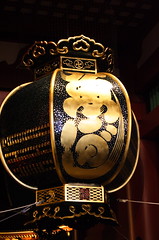
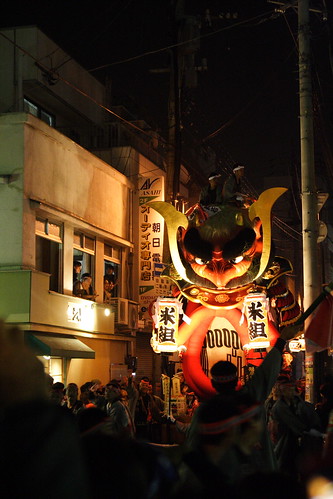
Anyhow — Friday Flickr for November the 2nd, 2007 is going to be a picture of my favorite float from Karatsu Kunchi, which I am missing right now. Besides being a massive three or four ton float, it was also featured on the Masterchef household Halloween pumpkin this year (there would be pictures of that instead, but I have a backlog of about 100 pictures from Cambodia and Zambia I still need to upload to Flickr first).

This is the helmet of Minamoto Yorimitsu, also known as Raikou, being partially devoured by the oni Shuten Doji, on the first night of Kunchi 2006.

October 23, 2007

Hope no-one sees me / Gettin' freaky

Japan: getting weirder since I've left? Discuss.

Counterargument: this is not a new story.

July 22, 2007

Catching Up


Went to Tokyo last weekend, got wet. Typhoon #4 of the season did some damage further south, on the opposite coast of Kyushu from where I live, but up at the capital all we got was constant rain. Not a whole lot to show for the trip other than a new pair of 20000-yen hiking shoes for my grand tour this summer; I was hoping we could at least see a few die-hard cosplay kids in Harajuku, but they were all in hiding apparently. This is a shot of Asakusa Shrine, on the first, mercifully rain-less evening; I last visited here seven years ago as a high school exchange student.

Now I'm busy preparing to leave Japan again. Had my last classes, and my last day of work, and now I have a full week to clear out my apartment and another two weeks after that to say goodbye. Finally got in touch with the Vietnamese embassy so I should have my last visa squared away by next week. Will try to write more later, but I have about 5000 items in my newsreader to catch up on, people to see, and an apartment to scour, so it may be a while yet.

August 10, 2006

A Habitat Story

Another one from my turn at the SagaBlog:


Back in elementary school, I went to a small, private Montessori school in Bloomington, Indiana. Fourth through sixth graders all shared one classroom, with about thirty students in all. Moving into a huge public middle school afterwards was a difficult social adjustment, but Montessori was a great learning environment. One of my classmates, two years below me, was a girl named Kelsey. Her father was a professor at Indiana University (as was mine), and her mother was from Africa. Which would've been unremarkable except that this was 1994 and she was from Rwanda.

Estimates range from 800,000 to well over a million killed in the Rwandan Genocide, primarily ethnic Tutsi people at the hands of organized Hutu militias. From Wikipedia's article on the topic:
Ordinary citizens were called on by local officials and government-sponsored radio to kill their neighbors and those who refused to kill were often killed themselves. "Either you took part in the massacres or you were massacred yourself," said one Hutu, rationalizing an ambivalent mixture of regret, fear, and shame at being forced to kill Tutsis.

Most of the victims were killed in their villages or in towns, often by their neighbors and fellow villagers. The militia members mostly killed their victims by chopping them up with machetes, although some army units used rifles. In some towns the victims were forcibly crammed into churches and school buildings, where Hutu extremist gangs massacred them.

Being all of eleven at the time, the full scope of this probably only vaguely registered with me at the time, but we were all definitely aware of it to some extent because Kelsey's mother was in the local paper (someone we knew was famous!) for her efforts to reunite with her family back in Rwanda. We had fundraisers at school to help her raise the money to travel to the refugee camps, searching for the scattered remnants of her family. I remember it took several trips, but she eventually was able to reunite with her mother. After some time — the details are blurry with time by now, but I think it must've taken over a year — she was finally able to secure a visa for her mother and her brother, who I believe were the only survivors in her family.


I first volunteered with Habitat for Humanity in high school; my school had a chapter and, on the suggestion of one of my favorite teachers, a sponsor of the club, a few friends of mine and I went out one Saturday to lend a hand on the house of a young woman named Jennifer. I don't remember exactly what I did that first time (I think I worked on the porch, and maybe some of the interior walls), but it was fun enough that when, later that year, the Unitarian Church that I attended at the time (that's another story) sponsored the construction of two houses out on the north side of town, I decided to go join them again. And whose house should I find myself raising the walls on my first Saturday morning there, but my old classmate Kelsey's uncle and the wife he met in the refugee camps of Rwanda some four or five years prior. And let me tell you, that was pretty cool.

Every weekend after, I dragged myself out of bed at 7:00 on a Saturday morning to drive out and take part in construction from start to near-finish: driving nails, putting up siding, drywalling, painting trim, running wiring all over the house with an old retired electrician my grandfather's age, and more. It was amazingly fun, and rewarding — and, as a teenager youth with your usual modicum of adolescent angst, also good for adding a little broader perspective to life. I continued my participation with Habitat on into college, where my constant involvement made it one of the defining aspects of my life at the time; it remains one of the things I miss most from home.


There is a Habitat for Humanity Japan affiliate, although it acts primarily as a coordinating and support service for groups taking Global Village trips to nearby countries in the Pacific. Volunteer organizations like Habitat are hard to find here in Japan; the word, ボランティア, is not native to the language and as I understand it normally carries connotations of group civic responsibility and shared sacrifice, like when my students are told to go out en masse to pick up trash along the roadside for an hour or so at school. That's good and important and all; our New Horizon third year textbooks have a unit on volunteerism, but there as well, the activities described are officially-sponsored (school groups with a partner family in Nepal — why oh why did they change it from Bangladesh this year??? I could've done a great lesson with that..) — not from grassroots.

There are a number of possible explanations for the relative absence of individual civic volunteerism in Japan. There are the obligatory references to Japan's "group culture", and the widespread influence of religious groups (Habitat, which is officially an ecumenical Christian organization, gets most of its volunteers and support from church groups, although everyone is welcome) in American social life, which Japan lacks. There's also the notion that these things are the responsibility of the government authorities, and not the general populace.

But there's also real legal impediments to the growth of non-governmental organizations (NGOs). In a 1999 article in the magazine Pacific Affairs entitled "Wither Japan's Environmental Movement? An Assessment of Problems and Prospects at the National Level", Robert J. Mason writes:
Perhaps the largest single obstacle facing NGOs is the difficulty of obtaining tax-exempt status. Indeed, 90 percent of all NGOs in Japan lack such status. To receive tax-exempt status, an NGO must be officially recognized by the government as a "public-interest corporation." Eligibility conditions for such status are not precisely specified by law, but what is generally required are either capital assets of about U.S.$ 2.5 million (¥300 million) or membership numbers beyond the reach of the vast majority of environmental organizations. What constitutes a sufficiently large membership base is decided by the ministry with which the NGO is affiliated. All public-interest corporations must be chartered by a government ministry, which will have a significant say regarding such matters as the group's activities and board membership. In short, the process is time-consuming and the requirements, while not clearly defined, can nonetheless be rigid and restrictive.

By comparison, registering an non-profit in the United States is a matter of filing a couple of forms with the IRS, which looks them over to ensure that the organization matches at least one of the large list of existing categories of charity — a process which usually only takes a couple months at most, and which is not meant to allow government or bureacucratic control of the groups. (In the UK, there's a Charity Comission, which as near as I can tell does pretty much the same thing; Canadians, Aussies, and Kiwis will have to give me a hint as to how your system works here.)


So, why are my students freezing away in dilapidated old buildings while the bureaucrats at the city hall stay warm and cozy? One possible answer is the equally underdeveloped state of Japan's volunteer organizations. A democratic government that truly represents the needs and concerns of its citizenry depends on civil society groups — churches, environmental groups, and other volunteer organizations where people associate together based on shared interests and goals — to transmit the concerns of the people to the authorities outside of the election cycle, as well as to hold them to them when it comes time to vote. So not only am I having an awesome good time when I volunteer with Habitat — I'm doing my part to keep democracy strong at the same time. And they usually have free donuts in the mornings too!

Taiwan and South Korea achieved peaceful transitions to democratic governance in the 1980s after small local religious and environmental organizations banded together to create a national movement capable of articulating a demand for reform and accountability of the government to the populace. The Chinese Communist Party — with good reason — fears just such movement today. And Karatsu — well, I'll be waiting.


Got more time to kill? Check out this site, which offers a longer article on NGOs in Japan and offers more comparisons to how they operate versus those in the U.S. For other articles I've come across relating to the broader topic of civil society, check out my del.icio.us shared bookmarks on the subject.
August 09, 2006

寒いですね

I originally wrote this post for the Saga JET communal blog, based on some thoughts that I've been turning over in my head for a while here. I'm not sure if they've really been fully expressed here, but it's a start. The post is reproduced below.


If I'm honest with myself, I have to admit that I'm not always sure about the degree to which my presence as an ALT here in Saga really makes a major difference in the lives and learning of my young students. I think that it might be doing something, perhaps in subtler ways than I can easily discern, but even with that thought it's not clear how much of it is directly connected to me, as opposed to any other friendly gaijin plunked down in my spot. I do think, though, that my being here has definitely had an effect on me, which I suppose is at least something.

Smack in the center of the sweltering Saga summer (say that five times fast), it may require a powerful stretch of the imagination, but if you'll recall it was only six or seven months ago that we were all sitting around, shivering in the biting Siberian-tinged air, tethered to the warm envelopment of the kotatsu. That is assuming we were at home; in the half-century old concrete hulks that serve as schools here in Karatsu, there was no respite. Except that, as a teacher, I could get away with wearing a heavy jacket, and retreat between classes to hover over the space heater in the shokuinshitsu to thaw my hands; unless they could think of an excuse to come visit a teacher for a few minutes, my poor sailor-suited students had no such escape.

I think it was probably the unreasonableness of teachers who would yell at students who dared to put on gloves or scarves in the frigid classrooms that was the most maddening aspect of it all, but almost equally galling was the thought that here I was, in one of the richest nations in the world, and they can't even manage to heat their children's schools! Aside from the basic issue of social priorities, the cold also had clear and demonstrable effects on the students' ability to learn and function — namely, they were too busy shivering to be bothered. It did give me an opportunity to teach the words "central heating" and "insulation", but that didn't really do much to solve the problem.

One day I expressed some of this frustration to one of my JTEs; her sympathetic response was "Yes, that's true... but Japan has no oil." At the time I think I was pretty dismissive of this idea: they appear to have enough energy to keep the city hall and the goddamn 7-11's warm, so I think there might be a little more to it than that. I still think that's the case — and tomorrow I'm going to make an effort to explain why I think these priorities might become distorted in the Japanese system —but I have to admit that her comment has stuck with me and, in a way, made me reconsider — or at least reassess — some of my assumptions.

I was born into an era of American supremacy. Although I was alive for its last few years, I have no memory of the Cold War, and my formative young adult years during the 1990s were ones where the American model appeared to be ascendant and essentially unchallenged. By virtue of my birth I have been extremely lucky in the opportunities available to me — the JET program's shared requirement of a college degree means we have all been extremely lucky, relative to the majority of the rest of the world today. In raising me I think my parents made a real effort (one I hope I'm able to emulate, some day) to ensure that I would be aware of and grateful for these gifts, and I've tried to do my part for others less fortunate, to date principally through volunteering with Habitat for Humanity during my four years at college. But surrounded by the social and physical infrastructure of the world superpower — clean water, cheap energy, good schools — it's hard not to take some of it for granted. The Japanese don't have abundant natural energy reserves, or a globe-spanning navy capable of stabilizing shipping lanes, or the world's biggest economy. The United States does, and while it doesn't explain the whole story about why my students are expected to suck it up and deal with freezing, uninsulated, unheated schools, I think it might well have more to do with it than I initially recognized. And if this is coming from the world's second-richest economy (even if we are living in one of its poorest sub-divisions), what about the rest of the world?

The implications of this are challenging. One of — if not the — best things I've done in my life has been my work with Habitat for Humanity. While I recognize that the elimination of substandard, poverty housing across the globe (as Habitat aims to do) is a goal far greater than anything I'll ever be able to achieve, I know that I have personally contributed my sweat and money and effort towards build an affordable home for over fifty families across the United States. However small the scale, that has made an undeniable impact for those families, helping them achieve a baseline of stability and opportunity, and I'm grateful for the chance to have been a part of it. (Building a house is, incidentally, also tons of fun.) But my experience in Japan, and on my trip to Bangladesh this past Golden Week on a Habitat Global Village trip, has shown me the great degree to which poverty can be relative. I don't think it diminishes the real need of poor Americans, but this gap between the U.S. standard of living and that of other countries may mean I have to reassess my assumptions. What constitutes a "simple, decent" home in the United States is drastically different from one in Haluaghat, Bangladesh, and one in Japan.

What's difficult about this is the accompanying notion that the world cannot, in fact, afford for all of its peoples to enjoy the standard of living that I as an upper-middle class American was born into thinking as "fair". And not just unaffordable in terms of monetary economics but also the natural resources that build and fuel that economy. To take an extreme example, China has been developing at full tilt for the last couple decades, the authority and legitimacy of the Communist Party largely dependent on continued economic success, and it still has huge masses of rural poor in its center waiting for their turn. Personal automobile ownership — a symbol of the American Dream if there ever was one — is growing, which is liable to raise demand for energy even further. China's growing hunger for energy reserves has driven up prices worldwide. All this development has had horrific environmental consequences, poisoning China's rivers, stripping its mountainsides, and polluting its air — and ours. An attempt by the whole world to bring their standards of living up to those of America, barring some miraculous discovery of cheap, clean energy, would probably have seriously negative consequences for the future.

America got there first — but can anyone else join us?

July 20, 2006

Kirishima National Park

July 02, 2006

"I'm like a rough diamond that just needs a little polishing, that's all"

So the other day I'm in Fukuoka (big city north of Karatsu) on my way to a concert at the Indian restaurant (kind of cool, but to tell the truth I prefer my sitar as delivered by Dan the Automator and DJ Shadow remixes) when I notice this Japanese woman on the street with bleach-blond hair and pink highlights at the tips. It's a pretty wierd look, even for the Japanese, who do like their fashion wierd, so I'm reaching for my camera in my bag to try and get a shot when all of a sudden she's standing there in front of me asking if I speak Japanese. "Uh, a little bit," I answer (no, not in English), and so she proceeds to explain that she and her friend (a guy who appears in short order) are students at a fashion school. Ok, that explains the hair. And they have a show on July 25th. Ok. And would I be willing to be a model for them?

Well, that was certainly a first, but unfortunately the 25th is not a weekend, so I had to pass (but not before getting flustered and asking "Really? No, seriously?" a couple times). I'd like to say that it was my keen sense of fashion (Habitat shirt, natch) that brought me to their notice, but as one of my other friends on the way to the same concert later said he was asked to star as well, I have to admit that it was probably my exotic gaijin good looks that did it. It's a shame, since having already starred in a promotional film for the city of Karatsu I could've been well on my way to a lucrative career in token star-dom.

I better enjoy this stuff while it lasts.

June 13, 2006

Fukushima


Fukushima
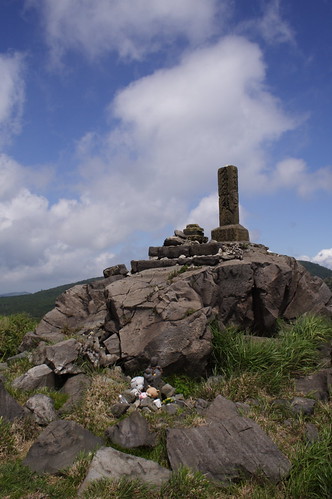
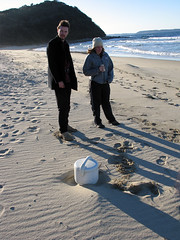
is a small island at the edge of nearby Nagasaki prefecture, to the south of us. At one point, there was an operation of some kind there -- possibly coal mining, although we didn't find the mine entrance -- now long since abandoned. Three hours of biking the back hills of southern Saga prefecture got us there, although the onset of summer had unleashed the undergrowth in such force that most of the complex was buried away from our eyes.

May 29, 2006

A Trip to Saga's Dirty South

Well, Kobe was nice enough, although I don't have much to show for it beyond a sheaf of handouts and a few new elementary school lesson plan ideas. I saw a little bit of the city, but only in the course of heading out to dinner in the evenings — as the guides suggested, it looked like a nice city for living, with a strong nightlife and plenty of nice restaurants to choose from, but didn't as much to offer for the visitor as your Kyoto or Sapporo or what have you.

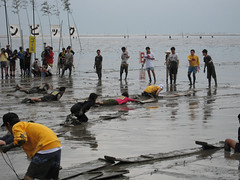
Far more exciting was the Sunday after I returned, when I took a trip to Kashima City to participate in the 22nd Annual Gatalympics. Kashima sits on the southern coast of Saga-ken, with huge mud flats (Japan's largest) stretching out as the Ariake Sea's tides recede — a product of one of the world's greatest tide differentials, with low tide at about six meters below the high point. Every year they have an annual "Mudflat (gata) Olympics", with locals, exchange students (there were even some Bangladeshi folks studying at Saga University) and a crowd of us ALTs mucking about in all manner of games. Saga gaijin came out in force, which the crowd of photographers there clearly loved; my event was the "World Cup", where I was roped together with four other JETs as we made a mad lunge to grab a replica of the real deal placed in the middle of an expanse of mud before some forty or so others made it there first. We didn't quite make it, but we had already been playing around in the mud for a good hour or so waiting for the event to start, so no one really cared. I was too covered in mud to go near my camera for most of it, but the whole thing was a filthy blast, and I'm still cleaning the stuff out of my ears.

May 23, 2006

Off to Kobe

Got a recontracting JETs conference to go to Wednesday — Friday, although I'm doubtful that there will be much new beyond the latest iterations of the "do your best" and "everyone's situation is different" speeches that are standard at all these things. At least I'll have a chance to see the city, which Lonely Planet tells me has recovered quite nicely from the quake a decade ago. Assuming I don't spend the entire time locked in a meeting hall, I should be back with some pictures at least.

Also, I graduated college a year ago today. Huh.

April 08, 2006

Kyushu Cup


The largest concentration of ALTs in the prefecture here is in the capital, Saga City — a number of them actually live together in a big apartment block, which I'm sure makes for a much different experience than what I get up here in comparatively remote Karatsu. I don't think I really envy them — college dorm life wasn't an experience I look back upon with any especially fond memories — but for better or worse they do seem to have a much tighter-knit community than Karatsu does.

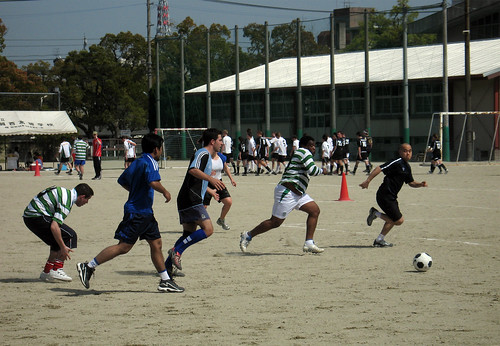
Thus events like the 2006 Kyushu Cup, a tourney of ALT amateur soccer teams from across the island (and one group from the tail-end of Honshu, Yamaguchi-ken) that Saga had the privelege of hosting this weekend. Of course, this was not amateur as in "anybody who'd like to get out and have some fun kicking the ball around" amateur, but rather more like "expat sports players from around the world, unite!" amateur, so I was there strictly as a specator (and vendor of snacks for Habitat for Humanity fundraising). It was also an occassion for an attempt at some sports photography, although I'm afraid my meager zoom lens capability prevented me from capturing anything too dramatic, like, say, a goal. This is maybe just as well, considering Saga's home-turf advantage proved insufficient to forestall the onslaught from champions Fukuoka-ken, resulting in a somewhat dispiriting fourth-place finish. Oh well — as the Japanese say, otsukaresamadeshita, everybody!

April 04, 2006

Hanami


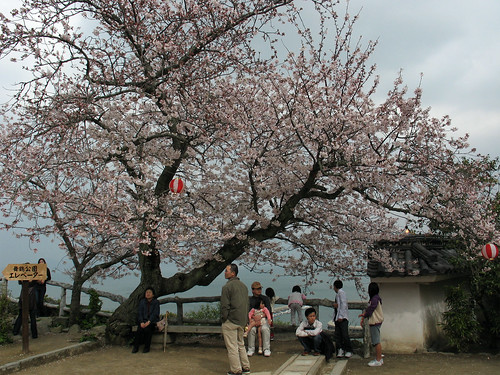
A group of us ALTs took a trip to the nearby Nagoya Castle ruins in Chinzei (from which Hideyoshi launched his invasion of Korea, way back when) at the start of the month to view the flowers, but it was overcast the whole day and I didn't get many good pictures out of it. This is from a short solo visit to Karatsu Castle the other day, where I ran into some students and many groups of Japanese out picnicking, drinking, and taking in the sakura blossoms.

April 01, 2006

Planned Obsolecence: Not Just For ALTs Anymore

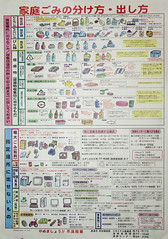
Japan is famously neurotic when it comes to sorting trash. You can certainly see why they might be picky about it — large landfills are hardly viable in a country this small and mountainous, so sorting out burnable or recyclable trash is going to be a necessity if you want to keep from being buried in a landscape of discarded Gundam figures and CC Lemon bottles. "Oh, isn't Japan such a clean country?" people back home sometimes remark. It's probably true that the bigger cities have a certain futuristic concrete-and-glass sterility to them — certainly compared to the couple of big European capitals I've visited (my most vivid memory of Paris back in 1995 will probably be the trash cans, lids sealed shut with trash piled atop everywhere you went, on account of Algerian elections-related-bombing fears) But unfortunately out here in Saga, one of nation's smallest and poorest prefectures, the recycling ideal set forth in the legal codes is not always exactly matched in practice. I sometimes get the sense that environmentalism here is often imbibed but not really 'digested' — it's there in the official slogans, but not as much embraced at the popular, individual level. It may not be a case of people not caring so much as a relatively weak tradition of civic participation in Japan, where people expect the bureaucracy to handle these matters (I think I see similar attitudes in regards to Japanese education, poverty, and housing standards, among others). Whether that's the case or not, I can say with fair certainty that 'clean' is not the first word I would use to describe the state of the Japanese environment today.

For one thing, many key pieces of infrastructure are displaying serious signs of age — I doubt if any of my school buildings are younger than twenty years old at best, and one of them I know to be over fifty. Insulation is but a distant memory (even in a lot of newer homes and apartments) and central heating, while found in the city hall and all the convenience stores in town, is not to be had in any of Karatsu's various halls of learning. (Of course, the kids are allowed to bundle up over their uniforms during the winter when all that air from Siberia descends down upon us, right? *Hollow laugh.*) I've even made a hobby of exploring ruined buildings in the area, products of a decade-long recession and the ongoing emptying of the countryside as the diminishing population concetrates increasingly closer to the larger urban centers.

More directly related to the trash issue is the fact that, given the choice between complicated, expensive sorting of one's refuse and a quick drive out into the countryside, it's not really especially surprising that many people opt for illegal dumping. While I shouldn't make sweeping generalizations about the whole country, I do know this isn't limited to Karatsu or its rural surroundings: I remember hiking along a road through the hills of Kyoto on a visit to my girlfriend in college once and passing refrigerators, microwaves, even a car, all chucked off the side of the road. Nor is it just the larger items: Karatsu's beaches, river and canals are regularly littered with trash of all varieties. Of course, not everyone dumps: those with the space just pile it up on their porch or in their yard. My neighbor for one has four refrigerators piled up under his awning, among other items, which would probably run about $45 a piece, were he or she to pay the disposal fees. Not surprisingly, ALT apartments tend to become crammed full of junk, as their continuously revolving roster of occupants pass their old and abandoned possessions onto their successors rather than pay for their disposal.

Now while this is all problematic — and I don't want to pretend the problem is unique to Japan, as you're liable to see the exact same sights out along the rural roads of South-Central Indiana — there is also the compounding factor that the Japanese people, frankly, buy a lot of junk. That junk in turn is consistently over-packaged: you have to be swift at the konbini if you want to forestall the near-automatic wrapping of your purchase, no matter how tiny it may be, in some sort of plastic bag. (Even then, some sort of universal convenience store code requires your sales clerk to affix a little sticker with the name of the store on it, just in case your delicious onigiri be mistaken for a competitor's, I guess.) Personal electronics — cell phones, DVD players, game systems, et cetera (although not as much personal computers, from what I've seen) as you might expect, are ubiquitous, even among families living in houses that I would normally be volunteering to tear down and build anew with Habitat were I back in the states. Used cars tend to be extremely cheap in Japan, because hardly anyone buys them, preferring the newer models. Basically, it seems as though, in the process of developing post-WW II on the strength of American consumption, Japan adopted the consumer society ethos to an even greater degree.

I think a lot of JETs living here in Japan tend to write off the strange or unusual practices of the Japanese (and since familiarity with Japan or Japanese is not a requirement for employment with JET, there is rarely a shortage of these to react to) as being just a matter of "the way they do things here" or "who the Japanese are"; in this they are not infrequently aided by Japanese people who would like to assert their nation's cultural distinctiveness. In matters such as this one, I think this attitude often overlooks the degree to which the Japanese state bureaucracy's regulatory decisions — whether consciously or not — have contributed to certain behaviors and disincentivized others. Charge high inspection fees for cars as they advance in age: people buy a new one every few years. Institute complicated, expensive trash disposal procedures: people dump their fridges in the woods or stack them up next to their house for years.

Require $2000 tests for old electronics items in the name of avoiding electric fires, while allowing an exception for their export, and you'll drive domestic second-hand retail shops out of business and their products either 1) into the junkyard or 2) into the export market — and, incidently, force Japanese consumers to pay for newer models instead. For a country that built its post-war recovery on the strength of a protectionist export-led growth model, this doesn't come as all that surprising of a move — although in this case it appears as though there is some confusion as to what will now be exempt from the law, as the ministries backtrack in the face of a big public outburst against it. If it does in fact go through, however, I imagine we can expect to see even more televisions and VCRs out there along the roadside in the years to come.