Planned Obsolecence: Not Just For ALTs Anymore
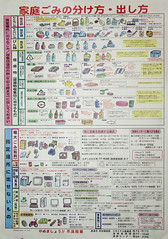 Japan is famously neurotic when it comes to sorting trash. You can certainly see why they might be picky about it — large landfills are hardly viable in a country this small and mountainous, so sorting out burnable or recyclable trash is going to be a necessity if you want to keep from being buried in a landscape of discarded Gundam figures and CC Lemon bottles. "Oh, isn't Japan such a clean country?" people back home sometimes remark. It's probably true that the bigger cities have a certain futuristic concrete-and-glass sterility to them — certainly compared to the couple of big European capitals I've visited (my most vivid memory of Paris back in 1995 will probably be the trash cans, lids sealed shut with trash piled atop everywhere you went, on account of Algerian elections-related-bombing fears) But unfortunately out here in Saga, one of nation's smallest and poorest prefectures, the recycling ideal set forth in the legal codes is not always exactly matched in practice. I sometimes get the sense that environmentalism here is often imbibed but not really 'digested' — it's there in the official slogans, but not as much embraced at the popular, individual level. It may not be a case of people not caring so much as a relatively weak tradition of civic participation in Japan, where people expect the bureaucracy to handle these matters (I think I see similar attitudes in regards to Japanese education, poverty, and housing standards, among others). Whether that's the case or not, I can say with fair certainty that 'clean' is not the first word I would use to describe the state of the Japanese environment today.
For one thing, many key pieces of infrastructure are displaying serious signs of age — I doubt if any of my school buildings are younger than twenty years old at best, and one of them I know to be over fifty. Insulation is but a distant memory (even in a lot of newer homes and apartments) and central heating, while found in the city hall and all the convenience stores in town, is not to be had in any of Karatsu's various halls of learning. (Of course, the kids are allowed to bundle up over their uniforms during the winter when all that air from Siberia descends down upon us, right? *Hollow laugh.*) I've even made a hobby of exploring ruined buildings in the area, products of a decade-long recession and the ongoing emptying of the countryside as the diminishing population concetrates increasingly closer to the larger urban centers.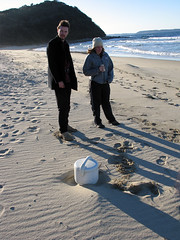 More directly related to the trash issue is the fact that, given the choice between complicated, expensive sorting of one's refuse and a quick drive out into the countryside, it's not really especially surprising that many people opt for illegal dumping. While I shouldn't make sweeping generalizations about the whole country, I do know this isn't limited to Karatsu or its rural surroundings: I remember hiking along a road through the hills of Kyoto on a visit to my girlfriend in college once and passing refrigerators, microwaves, even a car, all chucked off the side of the road. Nor is it just the larger items: Karatsu's beaches, river and canals are regularly littered with trash of all varieties. Of course, not everyone dumps: those with the space just pile it up on their porch or in their yard. My neighbor for one has four refrigerators piled up under his awning, among other items, which would probably run about $45 a piece, were he or she to pay the disposal fees. Not surprisingly, ALT apartments tend to become crammed full of junk, as their continuously revolving roster of occupants pass their old and abandoned possessions onto their successors rather than pay for their disposal.
Now while this is all problematic — and I don't want to pretend the problem is unique to Japan, as you're liable to see the exact same sights out along the rural roads of South-Central Indiana — there is also the compounding factor that the Japanese people, frankly, buy a lot of junk. That junk in turn is consistently over-packaged: you have to be swift at the konbini if you want to forestall the near-automatic wrapping of your purchase, no matter how tiny it may be, in some sort of plastic bag. (Even then, some sort of universal convenience store code requires your sales clerk to affix a little sticker with the name of the store on it, just in case your delicious onigiri be mistaken for a competitor's, I guess.) Personal electronics — cell phones, DVD players, game systems, et cetera (although not as much personal computers, from what I've seen) as you might expect, are ubiquitous, even among families living in houses that I would normally be volunteering to tear down and build anew with Habitat were I back in the states. Used cars tend to be extremely cheap in Japan, because hardly anyone buys them, preferring the newer models. Basically, it seems as though, in the process of developing post-WW II on the strength of American consumption, Japan adopted the consumer society ethos to an even greater degree.
I think a lot of JETs living here in Japan tend to write off the strange or unusual practices of the Japanese (and since familiarity with Japan or Japanese is not a requirement for employment with JET, there is rarely a shortage of these to react to) as being just a matter of "the way they do things here" or "who the Japanese are"; in this they are not infrequently aided by Japanese people who would like to assert their nation's cultural distinctiveness. In matters such as this one, I think this attitude often overlooks the degree to which the Japanese state bureaucracy's regulatory decisions — whether consciously or not — have contributed to certain behaviors and disincentivized others. Charge high inspection fees for cars as they advance in age: people buy a new one every few years. Institute complicated, expensive trash disposal procedures: people dump their fridges in the woods or stack them up next to their house for years.
Require $2000 tests for old electronics items in the name of avoiding electric fires, while allowing an exception for their export, and you'll drive domestic second-hand retail shops out of business and their products either 1) into the junkyard or 2) into the export market — and, incidently, force Japanese consumers to pay for newer models instead. For a country that built its post-war recovery on the strength of a protectionist export-led growth model, this doesn't come as all that surprising of a move — although in this case it appears as though there is some confusion as to what will now be exempt from the law, as the ministries backtrack in the face of a big public outburst against it. If it does in fact go through, however, I imagine we can expect to see even more televisions and VCRs out there along the roadside in the years to come.


