Ok, ok, so no, I was not eaten by any tigers, nor was there any romance by the riverside — it's just taken me a while to find the time where I can sit down and recall the full two weeks of my trip. I doubt I'll be able to do it much justice now, but I'd better try before it gets buried under the daily grind of Ken and Demi. So without further ado, here is another installment of "MC MasterChef's Travelogues Across Asia". If you feel like cutting straight to it, the pictures are here.
---The start of May is "Golden Week" here in Japan, also known as "the only time the Japanese ever allow themselves to take a holiday from work besides New Year's". It's a block of three or four national holidays all in the span of a week, and many families take the opportunity to take a trip to Tokyo Disneyland, the temples of Kyoto, the beaches of Okinawa, or some other attraction during this time. Being blessed in my JET contract with twenty paid vacation days and the mercenary work ethic that allows me to burn through them all without guilt, I took a full two weeks to go visit that hot-spot of tourism...
Bangladesh.
I went with a group of nine other JET teachers from my home prefecture of Saga, plus one young Japanese woman who was a friend of our team leader. The eleven of us spent the first couple of months of this year fundraising for our trip, and brought with us over $5000 in donations, which is about enough to build five solid homes in Bangladesh, including all materials, construction costs, and administration.
I took the bus up to Fukuoka International Airport early Saturday morning on the 22nd, where the full group met up and made our way to the plane. Oddly enough, there weren't an abundance of direct flights from Japan to Bangladesh, so we ended up going through Kuala Lumpur on Malaysia Airlines; on the way over, our layover was about six hours in KL, so we just hung around the (quite nice) airport, although the return trip gave us almost a full day to wander around the city.
No matter how far I'm going, air travel always seems to consume the whole day, and this was no exception: we arrived in Dhaka past midnight, which felt like about 3:00 AM back in Japan. We queued through immigration and picked up our bags, then stepped out into the muggy night air to face a crowd of men hanging around idly on the opposite site of high iron gates that shielded the taxi drive-up from the onlookers. We milled about uneasily for a few minutes, not sure what to do, before the HFH Bangladesh Volunteer Coordinator, whose name was Sanjay, showed up with two vans to whisk us out of there and off to our guest house for the night. As we hurtled down the nearly empty Airport Road, heat lighting rumbling overhead. Soon enough we were turning into the tree-lined Banani District, part of the upscale foreign and diplomatic quarter where most of the citie's better guest houses stand. I vividly remember passing a young Bangladeshi woman — alone as she was, at that time of night, I imagine she may have been a streetwalker — draped in a sari, standing in the shadows of a tree, with huge dark kohl-rimmed eyes staring back as our van passed.

Our first morning in Dhaka was devoted to changing money — not an easy process, as all of us had brought big blocks of yen, which the first place we went to either had no interest in or otherwise wasn't able to accomodate. Eventually we were able to get the cash taken care of, after which we went to visit the national Habitat Bangladesh offices. Besides adding another Habitat t-shirt to my ever-growing collection, I gained a bit more information about the country, which I'm really only broadly familiar with in the context of its separation from Pakistan back in 1971. A riverine country, floods and other natural disasters have taken a heavy toll on Bangladesh's development, as has serious corruption and governance problems and an increasingly dysfunctional political process — our departure from Dhaka to the Haluaghat affiliate where we would be building was delayed by several hours because opposition parties had called a general strike in an attempt to destablize the sitting government, which partisans often enforce by force . According to the briefing they presented to us, 70% of the country lives in substandard housing, of which 35 million are children. While NGOs and microcredit assistance programs are very active in the country, and the garment industry has found some success as a lost-cost exporter, its per capita income is only $440 a year, and most other indicators are
not much better. If that wasn't enough, a lot of the wells dug in the past to provide clean water for the countryside turned out to have significant levels of arsenic and other heavy metals in them — it was going to be bottled water for us, but the Bangladeshis didn't all have that luxury. Put it another way: the picture of Dhaka above is taken in what is supposed to be one of the nicer parts of the city.
By early evening the roads had opened up and we were able to begin the three hour drive to the affiliate of Haluaghat. We passed some pretty amazing scenes on our way up, some of which I was able to capture despite our driver's break-neck speeds. Bangladeshi rules of the road can essentially be summarized as "everybody yields to the biggest, noisiest, fastest vehicle". It was chaotic as hell and there were a couple points where we were bearing down on a huge oncoming
TATA Group heavy truck a little too fast for my liking, but amazingly the system seemed to work: rickshaw drivers really would pedal to the side of the road, and slower trucks would let you pass, and we did make it through the whole two weeks without any accidents, although sometimes I wonder how. After four hours or so of driving we arrived late at night at our guest house in Haluaghat, which was part of a hospital compound just outside the center of the market town.
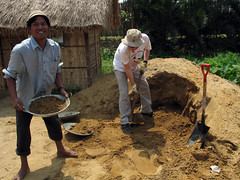
Our first day of building began the next day, Monday. There were two work sites, both a ways further out into the fields and villages around Haluaghat, and I worked a bit on the first one before switching mid-week; I wanted to mix groups around to get a chance to work with everyone, but people quickly became attached to their worksites and didn't want to move. Had I been leading the trip, I think I would've made a greater effort to mix people around, but oh well. I only got the story behind the first family. They owned their own land and were living in the parents-in-law's home, and sought to move out to something more spacious and more sustainable than the tin shack they were all living in. The father-in-law and the husband of the family were both masons, so they did most of the bricklaying work while we carried bricks, wetted them down (to aid in the setting of the cement) and shovelled big piles of dirt and sand into the house to fill up the foundation and raise the floor.
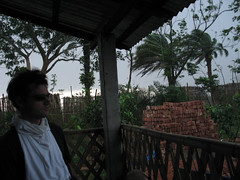
It was good sweaty work, of the kind that I've been increasingly desperate for during my extended time here in Japan, although late in the afternoon our labor was interrupted by a swift storm that blew up almost out of nowhere, forcing us to scramble to bring everything in before the rain came. I'm not sure if scrambling to scrape, shovel, and brush up a huge pile of drying grain into baskets while storm winds whipped up around us and the family's children all scurried to help was my favorite moment from the entire trip (and it might have been, now that I look back on it) but it certainly was an exciting way to finish a work day. We sat out the storm on their old porch and then walked back to the vans, it being too wet to do any more bricklaying for the day.
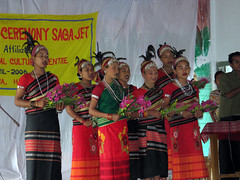
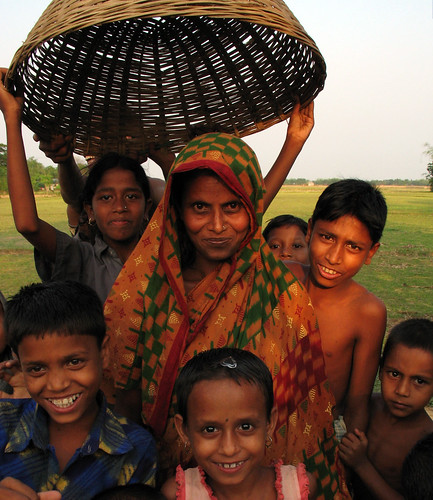
That evening we had our welcome ceremony at the local Tribal Welfare Association. The people living in the Haluaghat area were not ethnic Bangladeshis, but rather a tribal people known as the Garos, with their own distinct culture and language; as you can probably see in the pictures, many people had facial features far more reminiscent of Southeast Asia or the South Pacific than the Indian subcontinent. Not too many of them were Muslim, either, which means a lot of the cultural cautions we had been prepared against didn't actually end up applying. The welcome ceremony was pretty nice, although the master of ceremony's repeated exultations for us to welcome the next dancing group "with a big clapping!" were a little overbearing thanks to the speaker set up right next to our heads. Ah but they meant well.
The second day unfortunately was not so good — despite their having a special chef there for us at the guest house and using bottled water for everything from drinking to brushing teeth, something snuck its way down my digestive track and had me pretty well out of commission for the better part of the day, and decidedly off potato curry for the rest of the trip. I went home from the work site at about eleven, and slept until the others returned at 4:00. It sucked, because I really wanted to be working, but in the end that was it for me — and several others, like our team leader Aine, were not as lucky when they came down with stomach bugs later in the week which lasted several days.
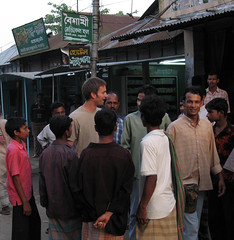
Fortunately, after sleeping most of the day I was well enough in the evening to join the rest of a group in an excursion into town, wandering around the marketplace at Haluaghat's center. Being a gaijin in Japan sort of prepares you for being an object of attention, but Bangladeshi curiosity towards visiting foreigners is if possible several of order of magnitudes greater than what I get here in Karatsu — we drew stares everywhere we went, and when one of our group stopped to buy a pair of sandals a crowd of twenty to thirty people congregated outside to watch. We were the first Global Village team to visit the Haluaghat affiliate, and if we weren't the first foreigners to ever visit, we were certainly a rare enough appearance to merit intense interest from anyone who saw us. It could be a little off-putting, although I don't think it bothered me quite as much as it did some of the others — I never felt ill will from the crowd, just maybe a few flickers of claustrophobia at moments. I can't imagine what they must've thought about us.
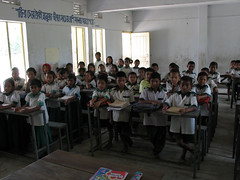
Wednesday morning we went to visit a local school rather the usual build; Aine and a few others had collected large donations of pencils, notebooks, and other school supplies, and so we went to deliver that and see school life in Bangladesh. The school was a Catholic one — apparently the Portuguese came through here, way back when, and a few were still around — serving all grades; we only visited the primary school part as the secondary school students were testing during the time. Many classrooms had over sixty students to them (although that may of been the entire grade, I think) and as the headmaster told us, many came to school without basic supplies or even breakfast. They were luckier than many of their peers, though, in that they were recieving some kind of education at all; many Bangladeshi kids their age were already working, and there were regular swarms of them around the second work site, where I went after lunch.
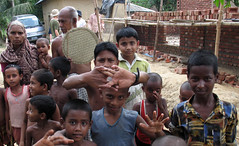
They worked alongside us carting bricks and shovelling sand — actually, they directed us on what to do, more often than not — and they also went mad whenever you pulled out a camera, so I had to be sneaky if I wanted a picture of something other than a crowd of kids pressing up on my camera. Still they were fun to work and play with, and a few older ones even spoke a bit of English.. in the interest of internationalization, we taught them how to count in Japanese too.
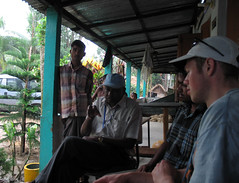
By the fourth day we were well into the rhythm of the work site, although our site had another break in the morning when a representative from another NGO in the area came to visit — word gets around about our visit — and asked if we would be interested in seeing their project. We took a break from building and drove a ways to a nearby village, where this group — I never got a name, although they suggested they were somehow affiliated with the UN — was working on improving agricultural techniques and developing artisan skills. About this time the sky opened up and dumped down several thousand gallons of rain, which meant we weren't able to see much of the facilities, but we did get an opportunity to sample some delicious, delicious chutney, which we bought about 20 jars of between the five of us.
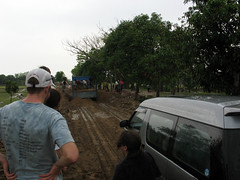
The rain blew off and we headed back along the dirt road to our build site... or should I say, the formerly dirt, now squelching mud road. This was one of the few situations where an SUV might've actually been useful, as our little minivan got itself stuck in the mud right behind a huge truck. Our driver must've done something awful to his transmission spinning his wheels trying to get out, but eventually with enough shoulder power we were able to shift the thing out, returning mud-splattered but triumphant to finish the rest of the day at work.
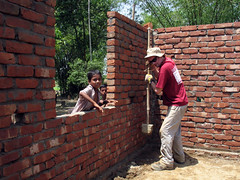
The next day was a solid work day — we pounded the floor level with a big cement block-tipped bamboo pole, then threw on more dirt, then pounded it flat again. Splashing bricks with water to help set the cement was also immensely enjoyable work. The next day was our final on the site, working till around 1:00, taking our farewell pictures with the family, and then returning back to the guest house to pack and prepare for the farewell ceremony, again at the Tribal Center. This time we performed a song and dance for them — "We All Want to Say Dhonnobad (Thank You) To You", to the tune of "Yellow Submarine" — and of course there were also plenty of dances for us to welcome with a big clapping. The whole thing lasted till the power cut out — not sure if that was intentional or not, but at a good two hours long, it was about time by then — after which we split up to do a "homestay" that evening. I ended up staying with two other guys and Sanjay at the house of the Haluaghat affiliate director, so homestay is perhaps overly generous — basically it was a bunch of sitting around, talking, and drinking, till far too late in the evening for me. I think everyone was pretty drained by this point, and having just bid our farewells it was a little difficult to play guest for the evening, but being in a big group I was able to let the others do the talking and excuse myself early (11:00ish) for bed. The next morning we woke up, loaded our vans, and made the drive back to Dhaka — which went allright, except for our late start and the radiator on our van blowing out on the freeway about ten minutes from our guest house. Good thing we had all those cases of bottled water...
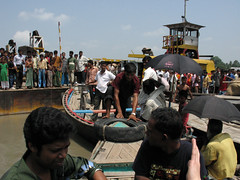
We had about four days to travel on our own, and Sanjay had earlier recommended a tour of the
Sundarbans, the largest mangrove forest in the world. Bangladeshi tourist infrastructure is fairly marginal, so we all agreed that a trip downriver sounded like the best option available to fill our last few days of travel. We met our tour guide that evening in Dhaka and paid about $300 apiece for a two night, three day cruise down through the forest and back. The next day a quick early morning flight on a 20-seater prop plane took us to Jessore, from which we took a big bus another hour or so south to the large port of Khulna, where we boarded our boat for the cruise.
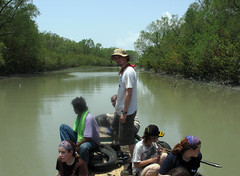
I kind of like the sensation of being contained in the separate world of a ship at sail, and this was quite a nice one to be spending time on, although there was a bit of cabin fever — probably inevitable given that we'd been spending the past week or more together as a group already. The cruise downriver took us all the way to the mouth of the Bay of Bengal, where on the second day we took a smaller skiff out down one of the side rivers deeper into the forest. No man-eating tigers — maybe just as well, as they kill about twenty people a year, and we had no desire to add to the tally — but there were plenty of mangroves, mudskippers, birds, and (from a distance too great for my camera) deer and monkeys to see. We went back to the boat for the lunch, then went out again to hike through a grassy area and onto a big white-sand beach for frisbee and driftwood cricket. The Sundarbans were quite beautiful, and it was a nice relaxing end to the build — although of course the trip wasn't over just yet.
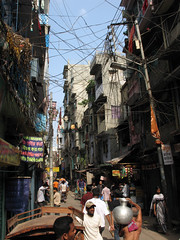
Our third day we boated back to Khulna, and spent a night in a hotel there — not a very restful one, as by my estimate I got only about four hours of sleep, at best. We departed at 5:30 AM for Jessore and from there flew on to Dhaka, where we went back to our first guest house, got two rooms to drop our stuff, and — after a mere hour nap, in my case — hit the town. Unfortunately, I had only a vague notion of where I wanted to go and what I wanted to see, so I was much less successful in my explorations than some of the rest of our group who went off separately — basically, I rode around in a succession of taxis, pedicabs, and rickshaws in an attempt to find things, and ended up missing most all of the attractions Lonely Planet had promised me were around there somewhere. It was fairly frustrating — especially since some of the other groups came back with the
lungis, spices, and cricket sets I had wanted to buy myself (well, maybe not the cricket set), and the only market I ever managed to find was one for sheet metal, which wasn't quite what I had in mind for a souvenir. In the end I had to admit defeat, took brief refuge in the Dhaka Sheraton cafe — a surreal island of wealth and air conditioning near the center of the city — and returned to our guest house empty-handed. So much for my day in Dhaka. There was no catching up on sleep either, as soon enough we were packing up and taxiing to the airport for our midnight departure. The music from
Star Wars as we boarded the plane — Luke Skywalker's theme, specifically — was a nice touch but didn't help all that much; I'm kind of hazy on the flight so I might've dozed a little bit, but I doubt that I could've slept for much more than one or two hours of the whole six-hour flight to Kuala Lumpur.
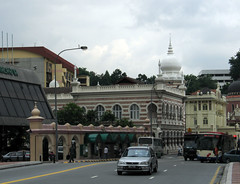
We had almost a full 20 hours to kill in KL before our second midnight departure in a row, so there was to be no rest for the weary here. I calculated at one point that, by the time I set foot on the plane that evening, I would've gone 64 hours on somewhere between six and ten hours of sleep — although the later number was almost assuredly too generous, and it was probably closer to the former. The KL airport air conditioning was far too cold to allow any comfortable sleep on their benches (I had packed my jacket in my checked bag back in Bangladesh) so it was out to explore the city for me. KL was a marked contrast to the squalor of Dhaka — Malaysia may still be developing, but you wouldn't guess it from downtown Kuala Lumpur, which hides whatever poverty there might be there very well. Had I been a little more coherent, I would've liked to have explored it more fully, as it seems like a pretty interesting place — certainly far more multiethnic than Japan, and at least as cosmopolitan in appearance as a big city like Fukuoka or Nagasaki. Sitting in the huge KL Petronas Towers mall, I was actually very strongly reminded of America — not just because of the shops and the money on display, but also the (comparatively) diverse crowd and the fact that Malaysia fashion sense appears to be much less... uh,
agressive than what you're liable to see wandering around the commercial hot spots of Japan.
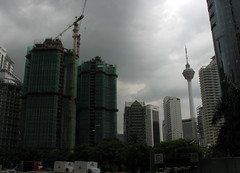
Of course, two hours of waiting around in a mall for the rest of my group to finish and my prolonged sleeplessness had me teetering a little bit on the edge by the end of it — mall culture is pretty disturbing even under the best of circumstances, and I was thoroughly horrified with it all by the time we escaped to dinner at the revolving restaurant at the top of the KL Tower. My appetite was pretty near gone and I was too stressed and exhausted to enjoy it, so I'm afraid it was a bit of a sour finish to the trip...
finally we made it back to the airport for our flight home to Fukuoka, which I was able to sleep a little bit on, I think. Eight or more hours later, I made it home to Karatsu, where I collapsed and slept until around 9:00 PM.
I had some high hopes for this trip, and in honesty I'm not sure I can say they were
totally met, although I've done this enough that I know I can't really expect
every build I go on to be "the best one ever". It certainly did feel much different building overseas than it does back home, though; our biggest contribution to the process there was clearly our substantial donation, rather than the raw unskilled labor of shifting dirt and bricks, which obviously Bangladesh has a fair amount of to spare already. When you're nailing two-by-foors and installing windows and fastening hurricane strapping, you physically
know your being there is contributing something to the process of improving people's lives... that feeling was slightly less evident here, although there was still enough work to go around that we could end the day good and sweaty and sore.
Being conspicuously, consciously wealthy relative to the rest of the local population was another fairly constant discomforting factor during my time there that probably had more to do with it being my first visit to a developing country than it did my work with Habitat (although doubtless a volunteering trip had me more conscious of it than travelling through by backpack would've). The priveleges of American birth is something I'm often aware of living here in Saga — I've actually been meaning to write more about it on here — but in Bangladesh you could rarely ever shake the sensation of being the rich (charity) tourists. A mere four bucks or so (more precisely, 250 taka) bought us buffet lunch at a fancy Indian restaurant with gated entry, guards, and a good dozen or more waiters (despite the fact that the buffet was self-serve). The feeling of being filthy rich was one of the subtle differences between building back at home and volunteering in a developing country that gave me this sense of, "we can't possibly be doing enough here".. the raw poverty of Dhaka and the remoteness of the Bangladeshi countryside limited my ability to take great satisfaction in a job otherwise well done.
Habitat for Humanity is not set up to — realistically, cannot — help everyone in the world, but the limited state of development in Bangladesh made it harder to celebrate our accomplishments at the end of the build; there was clearly so much more that needed to be done. I do believe that helping individual families is worth doing, if for no other reason than to make a difference in
some people's lives, and for having at least tried, but there's clearly much more to overcome in a country like Bangladesh than what I'm used to back home. Our visit to the school apparently inspired some of the students and teachers there to start their own volunteer group, though, so there's still hope for improvement, however incremental it might be.
All in all it was quite the trip, and I'm sure I'll be digesting its impact on me more as time passes. There's already talk of a trip to Nepal next year, although if that's the case I may not be leading it after all.. which would be sort of a shame, since, as fun as being a HFH participant is, I miss being Fearless Leader most of all. That's far in the future for the moment though, and for now I'd better stop here before this gets any longer.