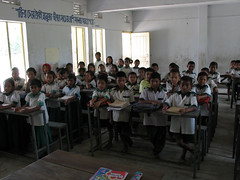
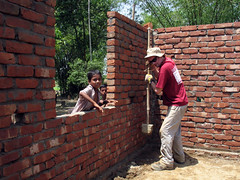
Showing posts with label habitat for humanity. Show all posts

October 23, 2007

Thoughts on Charity and Government

Ezra Klein makes what I think is an important point, which allows me to make a rare statement elaborating a bit of my own loosely-defined personal political theories. Ezra:

Charity is good for the giver and, generally, good for the receiver. But it's not what you build your society upon. It's not reliable, or predictable, or particularly targetable. Indeed, very little philanthropy actually goes into the areas that social policy focuses on. And that's because it's not supposed to. Charity, rather often, is a way to demonstrate virtue or compassion. Social policy, at least in theory, is a way to try and fix a structural problem. The two cannot be swapped in for each other.
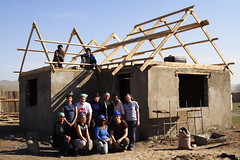
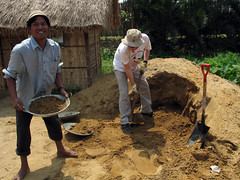
I've been an active supporter of the charity Habitat for Humanity for going on seven and a half years now. I have probably personally hammered nails, painted walls, or shoveled dirt at the sites of over 70 or 80 homes across the United States (and the world), and have worked with many of the future homeowners and hundreds of other volunteers in the course of doing so. I've donated a good bit of my own money to the cause as well, although I'm still at the stage in my life where donations of time and labor are a lot easier for me to make than monetary ones; having made such an investment at this point, though, it's reasonable to assume that those financial contributions will increase as my means to make them does.

I think Habitat does a lot of good work. And I am proud of the work I have done with it: through my efforts families have been able to achieve home ownership when they might otherwise never have enjoyed that stability that my fortunes have afforded me since birth. Habitat has offered a crucial hand up for these people and their lives have been impacted by it, just as those of the volunteers who work with them have. Developing a spirit of civic volunteerism is another important aspect of charity work, as I've attempted to express before. Private, non-governmental charitable groups play a very important role in policy-making, by advocating for issues and energizing constituencies to participate in the democratic political process. Living in politically apathetic Japan for two years made me realize how rich U.S. society is in that regard.

But the simple fact is that Habitat, for all its lofty vision, is not going to house the world on its own, one family at a time. There was an immense impact for every family whose home I have helped build, but on the national scale these are tiny changes — even more minuscule on the global scale. While charities may lead attention to an issue, ultimately I think broad changes, at the structural level as Ezra correctly seeks to place them, in major social policy areas like affordable housing, education, the environment, and health care, can only be effected by an agency as powerful and far-reaching as the government. And the fact that I do think it is just and proper for the government to be directed towards those goals is a major reason why I am not a conservative.

July 01, 2007

Once Upon A Time in the Steppes - Part Four

Read Part One // Read Part Two // Read Part Three


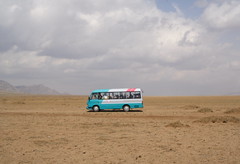
After finishing our lunch at the horse camp and throwing our bags into the bus we hit the road... or more accurately hit the dirt that was currently serving as road. We were heading the ruined monastery of Ovgon Khiid, where one of Mongolian Buddhism's founding figures, Zanabazar, once fled from rival armies. The guy chose a pretty good hiding spot, as we had to cross several horizons' worth of empty desert before coming across the rocky masses that sheltered the remnants of the shrine. The main temple ruins were apparently further back along a rocky, scrub-lined valley, but we contented ourselves with peeking inside a few of the contemporary shrines that a local family had been restoring since 1994. We were looking to get to Karakorum, site of Chinggis Khaan's old capital city, before evening, so we left the desert behind and eventually found our way to a road heading back eastwards.

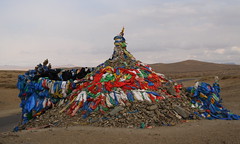
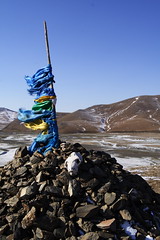
We stopped twice along the way; the first time was at a massive ovoo next to the road. One of my favorite sights during our travels, ovoo are cairns of small rocks and blue silk banners which dot the Mongolian roadsides, mountaintops, and other spiritually important locales. We saw dozens during the course of our trip. Custom is to circle the ovoo three times (or, if driving past, honk in recognition), adding a lose rock from the ground to the pile if one is free; we took the opportunity to throw the blessed rice we had received from the shaman back in Darkhan while wishing for good fortune and safe travels.

Our next stop was for a mother and daughter from Holland who had apparently forgotten to circle their ovoos, and whose touring van had caught a flat out in the middle of nowhere. We invited them into the bus along with their translator, driver, and the affronting tire. We chatted for a while before arriving at around six in the evening and dropping them off in Karakorum, their destination and ours. Modern Karakorum is a small town with a Soviet-era flour factory and not much else; there is, however, the large Erdene Zuu Buddhist monastery, Mongolia's first. When we arrived it was closing, however, and the wind had kicked up strong, sending us and the small herd of baby goats hanging around outside the walls running for cover. We planned to come back the next morning, and retired to a ger camp and short drive away on the edge of town, sheltered by some nearby mountains and with a river running nearby.

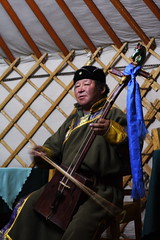
The gers, as usual, were cozy, and that night after dinner the camp offered entertainment in the form of a small concert inside the dining tent; one old man playing the morin khuur (horse fiddle), one performing khuumi (throat singing) and one young girl in a purple leotard performing a cringe-inducing contortion act. After the concert, we were offered a chance to try the instruments ourselves firsthand, which was cool. (They did not suggest we try the contortions.) We finished the evening with some card games in our gers; outside it had gotten even colder, and the crackling wood stove was a welcome tent-mate.

The next morning we woke up to .. snow! As I mentioned before, we had been told to expect all variety of weather during the Mongolian spring, but as cold as it got during our R&R I didn't really expect to be enjoying snowclad hillsides in the middle of May. The snow meant we could forget about hot water in the ger camp, so showers were out that morning; it was pretty enough that nobody complained, though. After a quick breakfast we hiked up one of the low mountains next to the camp, to see a monument at the top commemorating three great kingdoms in Mongolian history: those of (if my notes are right) the Hunus, the Turks, and Chinggis Khaan's own Mongolian empire. I need to learn more Central Asian history; if anyone out there reading this happens to have recommendations for a good introductory primer on the region, feel free to drop a note in the comments.


After winding our way down the hillside past more snow-covered ovoo, we left our ger camp and went to see Erdene Zuu. The monastery's walls (capped with a hundred eight stupa crenelations) were built from the remnants of Chinggis' capital, of which nothing now remains save for two turtle-shaped cornerstones that once marked the outer boundaries of the city. I have to admit that Erdene Zuu, while housing some beautiful art and architecture, didn't really capture my attention in the way some of our other travels in Mongolia did. Though I'm not given to religious sentiments in general, I personally find the worldly withdrawal of Buddhist ritual monasticism an unsatisfying response to the "life of suffering" they see around them. As visually interesting as the confusing array of religious symbolism present in their art may be, I can't help but wonder how much reassurance lay-practitioners really derive from the thought that the monks whom they supported through tithing and donations have now passed on to enlightenment while they remain behind. It's not really for me to judge, I guess, but it all felt very ornate in an otherwise very barren land. Anyhow, we left the monastery and stopped on our way out of town to see the second surviving turtle rock — which was up on the mountainside quite a ways from the first, suggesting Karakorum's large size in its day. We ate a lunch of sausage and cucumber sandwiches in the van as we bounced along listening to a tape of Mongolian pop balads, travelling back in the direction of Ulaan Bator.

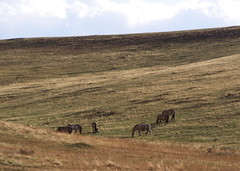
We weren't done with our travels yet, though, as we had one more stop planned: Khustain National Park, home of the Mongolian takhi, also known as Przewalski's wild horse. We arrived after several hours of driving and settled into the ger camp there, figuring we would go out to see the horses after dinner; we got word, however, that the wind was picking up and a nearby herd was likely going to start moving, so the best time to go seem them would be now. The takhi are true wild horses, genetically distinct from domesticated breeds or feral horses (domesticated horses that have escaped human captivity and gone wild). Short, stocky, and sandy-colored, they had vanished from their natural habitats until reintroduction programs begun in the 1990s started reintroducing them to Mongolian national parks like Khustai. The herd or around a dozen we saw, grazing at a distance of several hundred yards away (too far for my lens zoom to get a good capture, I'm afraid), had several pregnant females amongst it, and Khustai alone now has over 150 of the animals living in its area.

We saw some horses of the domesticated kind up close after dinner that evening, as two local cowboys were offering the chance to go on a dusk ride for something like two dollars per person. Though not as free ranging as our first experience — we went out in small groups of four and spent the entire ride tethered close to our two guides, so no unscheduled departures for me this time — it was still nice to ride out under clear night skies.


The next morning we had an early breakfast and made the drive back to Ulaan Bator, where our R&R officially concluded. We planned to return to the care of the national HFH offices for a few farewell ceremonies before our late evening flight out, but Batbold the national coordinator was busy in meetings for the moment so we stayed with our tour guides a little longer. We checked into the same hotel we stayed at our first night and got two rooms to store our bags in, then left with the tour bus to downtown UB in search of an internet cafe. There we filled our some surveys for HFH Mongolia and said some tearful goodbyes to our guide and translator, Ogi... until she came back some twenty minutes later, off work, and offered to show us around one last time at the national Natural History Museum that some of us had hoped to catch sight of while we were there. It was a bit of a whirlwind tour, as we had to meet Batbold for lunch soon afterwards, but we managed to see most everything on display — lots of unlucky stuffed animals, both native to Mongolia and otherwise, and one large exhibit of dinosaur bones, Mongolia's claim to international paleontological fame. No cast replicas either, these were the actual bones dug out of the Gobi rock — including, under protective glass case, the famous fossil of the protoceratops locked in combat with a small raptor. Pretty cool stuff, although unfortunately we took no pictures. After that we did say goodbye to Ogi, and went by cab to meet Batbold for a quick lunch.

Then it was shopping time — an hour and a half in the Ulaan Bator State Department Store. I'm guessing shelves have improved considerably since Soviet times, as almost all floors were filled with shoppers stocking up, as we were, on souvenirs, food, and gifts. Mongolia HFH evidently didn't have their own t-shirts, so I had to buy a general Mongolian flag one for myself, as well as a patch for the old hiking bag; I also brought back after much deliberation a horse fiddle for Ms. Riddarfjarden, who is a cello player and quite fond of their sound. Though still half-full from our late lunch, it was then time to head on to our thank-you dinner at ... yes, Mongolian barbecue! Although technically, speaking, it's neither, it was still pretty delicious. We also received thank-you certificates and met with one of the Mongolia HFH national affiliate's board members and his young son, who really didn't want to be there with us, even when bribed with ice cream. The rest of the HFH folks were very appreciative, though, and it was a nice meal, albeit a little rushed at the end as we had one more sight to see.

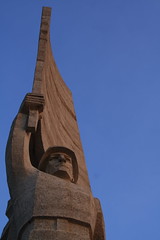
The national Tumen Ekh ensemble performs traditional Mongolian dance, songs, throat singing, moriin khuur, and more contortionists. It was a great performance.. so suffice it so say I was extremely frustrated when my camera battery died off five minutes into the performance. You'll just have to trust me when I say it was impressive, I suppose. After that we took a drive up to Zaisan Memorial, which I was able to briefly capture thanks to five minutes of quick battery-charging in the bathroom after the concert. A large hill overlooking the whole of Ulaan Bator below, Zaisan on that evening was swarming with recently graduated high school students, wedding parties, and other folks out enjoying the panoramic views; we made quite a few friends with the younger kids, whose English put our shogakkusei here in Japan to shame. The monument, dedicated to Russian-Mongolian friendship, had some pretty classic Soviet-era murals too. Eventually we made our way back down and regretfully headed back to the hotel to pack up and leave UB behind.


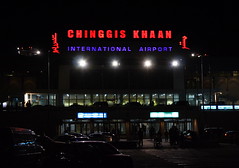
We took off from Ulaan Bator at around midnight and touched down in Seoul at around four in the morning local time. There we dragged ourselves through customs — just a tip, if you buy duty-free alcohol in Chinggis Khaan International Airport, remember your receipt if you don't want to run afoul of liquid carry-on rules when you transfer in Korea — and collapsed onto the waiting couches. I stayed up while the others napped, and watched the airport wake up around us; I had just enough energy for a last-minute run to the Dunkin' Donuts on the far side of the terminal for some jelly-filled fuel before it was time to board again at around 7:30. From there it was a short flight back to Fukuoka and the breaking of the fellowship; my Fearless Leader duties discharged with everyone back safe and sound, I caught the train back to Karatsu and began the task of catching up on about two week's worth of sleep.

---


Ok, so, now it's retrospective time. While two years living in Japan may have reduced the number of Habitat trips I organize on a yearly basis considerably from its peak in college, I think I can say that my Fearless Leading skills have not been totally dulled from disuse. While I know there were instances where I could've handled things better, for the most part I think I was able to stay calm, flexible, and on top of most problems that cropped up, both beforehand and during the trip. I can say that I don't think I would've been able to pull together all the disparate components of the trip and kept things organized and on a relatively smooth course had I not had the experience of leading similar (if not always as complex) excursions back in the states. While my team members said some kind things about my leadership afterwards, the truth is it was the Mongolia HFH and Darkhan affiliates who made our time as rewarding as it was, and my role was largely that of a facilitator for those experiences, a role which I find myself happy to play. I have worked with a lot of Habitat affiliates — over two dozen at least — in my years of volunteering with the organization and Mongolia HFH was definitely one of the best I've ever built with, in terms of providing real, rewarding work for its Global Village team participants. I would highly recommend it, and Mongolia, to anyone as a destination worth exploring.

I recently read this post on the slacktivist blog about the rationales behind mission trips and other service programs; although our team was independent of any church affiliation and the group a largely areligious one, I still think this example (speaking of a hypothetical trip to build a schoolhouse in Haiti) would apply to our excursion as well. Speaking to the question of, "couldn't we use the money on service programs some better way", he writes:
But the point of these mission trips is not only to get the school built. That's part of it, but it's not the only goal. The mission trip is also designed to give the American youth group a tangible, visceral stake in the fate of the Haitian community. This is vital for the people in Haiti too. ... It's unlikely that the youth group, the church, or any other given community here would raise the same amount of money without the personal stake of the trip itself.

The purpose of the mission trip is not exclusively to change the Haitian community where the school is to be built. Part of the purpose of the trip is also to change the young Americans who are going there, and to change the community that sends them. Part of the reason for such trips is to nurture a sense of empathy, of solidarity, and an ethos of service -- to create and maintain the capacity to care whether or not children in Haiti have a decent place to go to school, and to create and maintain the desire to help.

It's a big world, and there are no shortage of problems in it. Mongolia is a big country, with its own share of problems as well. I hope that our team's contributions — over 600,000 yen worth, once I get the last of the donations sent along — can be used as a seed for future investment in affordable housing in Darkhan, and I know that there are two families there who now have strong, decent housing in part thanks to our efforts. I have to think that counts for something, but I also know it's not enough to stop there. If my work as team leader, and the far more critical work of the local Habitat employees, guys like Baynaa and Batbold, has helped spread the message that the people of Mongolia are worth caring about, then I think I can consider this trip an accomplishment.

Hopefully there will be more to come.

June 22, 2007

Once Upon A Time in the Steppes - Part Three

Read Part One // Read Part Two // Read Part Four


Ok, here it is, late as usual; part three of my Mongolian travels.
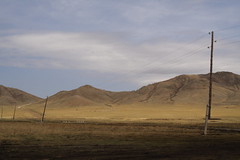
Sunday morning was gray and cold as we woke up, but sleeping an extra hour helped make up somewhat for the late night of partying it up at "Club Scorpion". Baynaa, Bob the translator from our first tour around Darkhan, and our driver Baatar met us with the van at nine. With Sunday off, we had made a plan to visit Amarbayasgalant Khiid, an old Buddhist monastery and shrine west of Darkhan. After first stopping at the grocery store to pick up bread, sausage, and cheese for a picnic lunch, we drove for about an hour before turning off paved road onto a dirt track. After fording a few small streams — one big lesson learned from our trip in Mongolia was, "cars that you would not necessarily assume to be off-road vehicles, can in fact be used as such" — and driving on for about another hour, we reached the monastery complex at around noon.
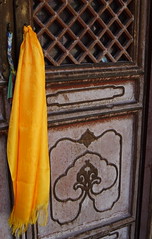
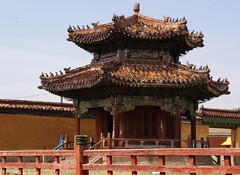
Amarbayasgalant is one of Mongolia's greatest architectural treasures, having survived the advent of the Communists in 1937 with only about a quarter of the complex's temples destroyed. It was built by the Manchu emperor in the 1730s, and as such shares lots of stylistic similarities with other Buddhist temples I've visited in Korea and Japan, though the red ochre walls and wooden roofs gave it a distinctive look of its own. Restoration work supported by UNESCO aid and visitors' fees has been ongoing since 1975 and about 70 monks currently live there, one of whom showed us around the halls.


After we walked around the main temple complex Baynaa and Bob told us we would be driving further back in the valley to where a collection of stupas was perched on the slope. We left the monastery complex at the valley center, and bounced across the fields in the van. As we approached the stupas we started to pass through stands of birch trees, which stretched out northwards towards the mountains. It was gorgeous countryside for a picnic. We forded a small river running between the birch forest; the stupas were in sight cresting the hilltop ahead of us.

We started to ford another river up ahead... and sunk to a stop.

There are a lot of things to worry about when you're leading a group of eleven people on an international volunteering trip. And I did no shortage of worrying this trip. But there we were, stuck in a river in the middle of nowhere, and I have to say I wasn't worried. Yes, our back wheels were sunk six inches under the riverbed. Yes, after we all carefully tiptoed our way out onto the riverbank on a log (that water was cold) to reduce the weight, and sat back to watch our driver give it a second try, all that produced was a big froth of bubbles and some smoke from our equally submerged tailpipe. Still: not worried. Yes, the monastery was by this point a loooong walk away, and who knows how long it would take us to get back to Darkhan. But you've just got to figure this sort of thing happens a lot in Mongolia, and Baynaa, our driver Bataar, and Bob were clearly doing their best to figure out some sort of solution. So: sit back, relax, enjoy the scenery, and trust the locals to know what they're doing.
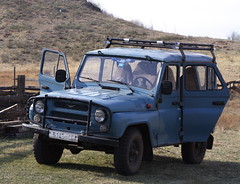
Deliverance arrived in the form of four monks (two older, two young boys) in a battered old Russian jeep. We were lucky, since we could've been waiting there for hours; instead it was more like twenty minutes. They happened to be on their way up to the stupas, where there was another small quarters for them, the caretakers. Fishing a rope out of the back of their jeep, we tied it to the front of our van and they lurched forward — only to have the rope fly off with a snap as it broke. Undaunted, Baynaa and Bataar then sprinted up the hill to the monk's house, coming back with a six-foot steel cable that they once again set about securing as we watched and shared some cookies with the two young monks-in-training. With a lurch, a groan of the cable, a splash, and a cheer from us onlookers, the van came free! And so we climbed pack in and carefully made our way up the hill after the monks, coming to a stop next to their house just a few yards away from the stupas and another small shrine.

We celebrated our escape with a picnic lunch of dried fruit, delicious sausage and cheese, and at this point very crumbly bread. Afterwards one of the monks, a middle-aged fellow who had learned English during a four-year stay in Switzerland, showed us inside the shrine where we admired the paintings and icons. We then hiked up a ways further above the stupas, getting a view of the valley below.
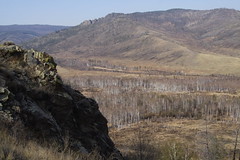


Eventually it was time to head back; the monks accompanied us down, but this time we all got out before the van attempted the river crossing and it went over without a problem. We spent the four hours back playing twenty questions, and had a late dinner at about nine in the evening.
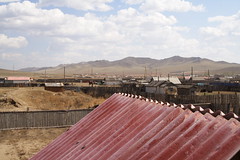
The next day we were back to work, with me on the first house. We started the morning doing some insulation work, filling the cracks between the wall tops and the wooden frames at the roof's base with cut up cement bagging. It was a bit of a slow day, getting back into the work routine, but in the afternoon we began installing "shipu", which is the Mongolian word (actually borrowed from Russian) for the big red fiberglass shingles that formed the house's roof. In the evening we visited a restaurant mentioned in the Lonely Planet, the "Texas Cafe"; I would not necessarily have expected to be eating tex-mex food in Mongolia, but the place itself had all the touches of a US steakhouse chain and the food turned out to be pretty good. In the evening we came back to the hotel and I watched some Mark Wahlberg-is-a-crazy-stalker movie with the others. Bad, extremely bad.
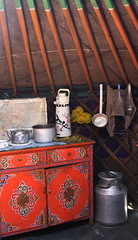
Tuesday was our last full day of work, and I spent it working on the second house. The wind was kicking up dust so we were invited inside the family ger, where we all sat around the stove in a circle watching Celine Dion music videos on the small television and making roofing nails, Mongolian-style — cut out a circle of rubber from some old strips of tire, place a bottle cap on top, and pound a nail through the cap and rubber to complete it. We got a pretty good system going between the five of us, and the morning passed quickly; that afternoon I got back up on the roof and helped install more shingles with the construction supervisor Ghana and Chotto the homeowner. We broke early at around four and took a trip to the local "black market", where the others bought clothes and I watched the locals play billiards outdoors. We had another dinner at the Texas cafe, and I spent a while in the local net cafe attempting to catch up on e-mail before preparing to head back and pack up for our departure the next day. That, at least, was the plan.

So, remember how I said that going to a club in Mongolia was an interesting experience, but that it wasn't necessarily one that I was keen to repeat ("how-did-I-get-myself-into-this" interesting, not "boy-this-is-fun" interesting)? Well... so much for that. Because one disco outing is just not enough, it somehow happened that we were to go clubbing again on our last night in Darkhan — not my idea, I can assure you, but Baynaa and the other Habitat folks seemed enthusiastic when the suggestion reached them. So enthusiastic, in fact, that it became pretty clear they expected that we would all be going again, despite the fact that many of us (me included) were tired and would prefer spending the night packing and preparing for our last morning in Darkhan. Well, being the responsible leader that I am, I went along anyhow, and so got to hear that stupid "Hot Like Me" song, which the Mongolian nightclubs apparently love, for the hundreth time that trip. The club was in what looked like could've been a big observatory dome, except that the floor was ringed by blacklit booths and instead of a telescope there were poles and more strobe lights. The entertainment, besides the bad dance music, was a guy with a shock of dyed blond hair who, if I understood this right, was the winner of "Mongolian Idol" or whatever the equivalent is — though he most just MC'ed rather than any singing. I passed on the dancing and the drinking and sat and squinted some more. I also talked a bit with our driver Bataar, and Baynaa. Baynaa told me he thought I would be a good manager some day. I'm pretty sure he meant that as a compliment so I'll take it as such. This club, like the other one, finally shut down at midnight, at which point we all staggered back to the hotel, where I finished packing, washed some socks in the sink, and finally got to bed at about one in the morning.

The next morning we woke up early, hauled our bags downstairs, and had our last breakfast at the Urtuuchin Hotel. I initially thought we would have to check out entirely, but it turned out we were going to come back for lunch before leaving for UB again, so we piled all of our bags in one room and settled the minibar bills. As we loaded into the van at around nine another dusty pall was hanging in the air — the wind had picked up, strong, and tan clouds obscured much of Darkhan as we drove out to the homes we had helped build for the last time.
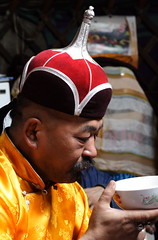
Our first visit was at Chotto's house, where we piled out into the dust storm. We were quickly invited into the family ger, where we saw that we weren't the only visitor — a stocky older man with a big moustache, brilliant orange tunic, and classic Mongolian hat was perched on a stool at the seat of honor opposite the low entryway. He was, it turned out, Chotto's elder brother, visiting from Ulaan Bataar. He was also, incidentally, a bo — a Mongolian shaman. We sat and visited with him for a long time, as he talked with us, asking us about our experiences and thanking us as his brother looked on shyly. Some of our talk was appropriately cryptic as well, such as his personal message to me that "you should ride a camel". At one point he produced a marmot-skin bag, from which he offered us each a handful of blessed rice, which we were told to scatter at a shrine on our travels to bring good fortune, a nice gift to be sure. I have to say having tea with a shaman was a first, and meeting this fellow an experience to remember; definitely not the kind of thing we would've been able to see without the connections we made through our work with the Habitat families. Finally we had to say our thanks and depart for the other home, as it was approaching eleven by that point.
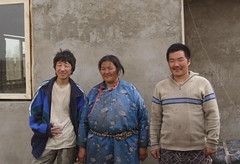
Our stop at Ghana's house was somewhat briefer, which was sort of too bad since I had spent most of my time with the crew over there. But the hospitality was equally warm; we took shelter from the dust inside their home, which had just been installed with a door and windows. Inside, Ghana, who is a chef, presented us all a "Thank You" cake, and we celebrated with frosting-covered slices, and a bottle of vodka which we mercifully decided to save until some other time. Far too soon time was up and we had to say our goodbyes; then it was back to the hotel to pay our bills, grab our bags, and have lunch with the Darkhan affiliate staff. With many thanks, we finally said our last goodbyes to our hosts and packed ourselves into the van next to all our bags, heading towards UB and our R&R.
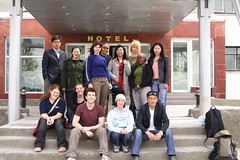


We arrived there four hours later at the offices of our tour guides, where we met our new driver, an older fellow named Bagi, and translator and guide, a friendly middle-aged woman named Ogi. We passed our bags into the large green Korean tour bus and said our goodbyes to Baynaa and our awesome driver Bataar; they were heading back to Darkhan. We, meanwhile, were heading west to the "Little Gobi" region (not the Gobi desert proper, which is further south and which we would've had to go to by plane), for camping, horseback riding, and other sights.

I notice that I haven't said much about the Mongolian road system yet, which is definitely worth a mention now. In a word, it is bad. It is also, rather frequently, nonexistent. This is not necessarily unexpected in a country with the lowest population density in the world, but still, it made for some rough travel. Infrastructure is something those of us lucky to enjoy it should all seriously appreciate; distances that on paved US highways would've taken perhaps two hours, tops, instead took five or six. The road we travelled on westward from Ulaan Bataar is Mongolian's longest, I believe, and at regular points we swerved off the cracked and potholed surface to follow dirt tracks running parallel — which were there, we soon saw, on account that in several places unfinished drainage ditches split the road surface entirely, forcing you to go off and around. Some day Mongolian road crews may come along and finish those, but I'm pretty sure we spent more time off the road than on; although the tour bus was roomier than the trusty van we came down from Darkhan in, it did not have a lot going for it in the shock absorber department, and our hiking bags would go flying up from the back on regular intervals as we hit a particularly deep bump. Again: it doesn't take an SUV to go offroad. But, there are some times when it might be nice.
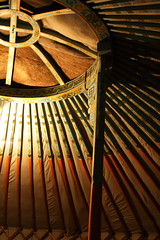
As for rest stops, forget it — it was the great outdoors for us when nature called. We made a few brief stops but mostly continued pushing on until late in the night, snacking on bread and dried fruit and watching the steppes roll by. Eventually it got dark, and cold, and we huddled up in the seats in an attempt to catch some sleep; it was after eleven when we finally pulled off onto a long dirt road that finally led us (after a few wheel-spinning stops in the sand) to our ger camp. After unloading we split up into our gers, which were warm and cozy thanks to the fires roaring in the central stoves; we skipped dinner and I fell straight asleep after making the rounds to distribute water bottles to everyone. It was a pretty exhausting day.
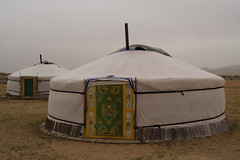


The next morning I woke up to the cold — the fire had eventually gone out during the night, and the temperature had plummeted from what we had been experiencing in Darkhan. We were told to expect crazy weather in the Mongolian spring, and we ended up experiencing more or less everything during the two weeks there — dust storms, dry heat, brief rain, shivering cold. It actually stayed cold for the entirety of our R&R period, so it's a good thing I had warned everyone to prepare for it beforehand — up till that point, nobody had thought we were going to actually need our coats and long-sleeve layers, but we had a use for them in the end after all. We had breakfast at the ger camp's "restaurant tent" and met a fellow from Denmark travelling with his father; they had come all this way by rail, amazingly enough, and were continuing on to Lhasa, with the goal of taking the new Himalayan train line recently completed by the Chinese. After chatting with them for a while and warming up on hot tea, we headed out to the windy edge of our camp, where a line of horses were hitched up to two posts. It was horseback riding time!

Ms. Riddarfjarden, with whom I went horseback riding for the very first time ever in New Zealand this past January, was very clear about what I should say when it came time to saddle up, to the point where we practiced several times beforehand: "What are you going to say when they ask you if you've ridden before?" "No, this is my first time." Having gone riding enough times herself to be wary of letting on any experience, for fear of being saddled with an ornery steed, she was adamant that I was not to end up bucking around on any half-tamed beasts. In which I was in full agreement. When it came time to saddle up, however, nobody bothered to ask me anything, and I barely had time to ask "is this a nice horse?" before they had me mount up on a ginger steed with a buzz-cut mane. "Yes", they assured me, he was. Ok, well, we'll see.
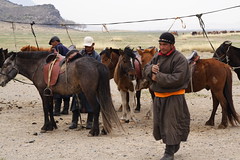


Mongolian horses are shorter and stockier than the retired racehorses we rode in New Zealand, which helped mitigate most of the feelings of being perched precariously high above the ground on a semi-intelligent creature that I had felt then (mostly during the times when we went cantering along the rocky riverbeds). They are also, we were warned, shy — don't make loud noises, don't use flash photography, we were warned, unless you want to go flying over the horizon. Duly noted, we assured them. "If your horse takes off, just don't fall off, we'll catch up to you eventually", I half-jokingly told everyone, not wanting to think about what we would do if we had a medical emergency out here in what appeared to be literally the middle of nowhere (the handful of gers where we had spent the night aside), a long and bumpy six hours' drive away from UB. Loaded up with my camera, backpack full of Fearless Leader emergency supplies, and bundled up in jacket, pants, and bandanna, I can't say I quite matched our Mongolian cowboy guides for style, but it was still pretty cool riding out onto the flat open plain around our camp. Four or five of them rode along with the ten of us, teaching us a bit of horsemanship along the way — "giddyup", for the record, is "chu" in Mongolian.
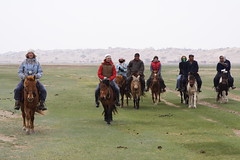


We loped our way across the plain for a while, easing into the saddle. Our horses had just been roped in from a larger herd that was roaming around the plains next to the camp; not wild, I guess, but there were too many of them to have individual names. Mine was handling all right thus far; as one of the last to saddle up, I was towards the rear of the pack. We came to a small stream and began to cross; most of the rest of them were already on the other side when mine stopped for a leisurely drink. I let him go at for a bit, but not wanting to get left behind, I tugged on the reins after a bit and urged him up the bank, muttering "chu!" to him and leaning forward as I tried to catch up. And, well, "chu" he did — off we bolted.

I am told by those who saw the whole thing that it apparently looked like I knew what I was doing. Back straight, head high, reins in hand, whoosh, there I go. Which is good to know. In fact, I was mostly just busy trying not to fall off. My horse sped past the main group, onwards and, it became swiftly apparent, upwards, as he started to head up a hill up ahead. "Pull on the reins!" people shouted after me. "Easier said then done when you're bouncing along at full gallop with a backpack full of first aid kit and a camera bag slung around your side!" I did not respond back, since, as I said, I was too busy following my own advice, keeping both hands gripped firmly on the saddle pommel and working on priority number one, Not Falling Off. "That hill is rocky", I thought to myself. "So what?" my horse thought to itself, and kept going. "There goes another one," our cowboy guides thought to themselves, and one took off to rescue me. Fortunately, however, the hill started to work in my favor as the horse had to slow down enough to the point where I could risk letting going with one hand and hauling back on the reins. He slowed some more, which was good because at about this point one of my feet bounced out of the stirrups. Finally — and when I say finally, I mean, "after possibly a minute or two at most from the start of this all" — he stopped. The young cowboy who had taken off after me pulled up and jumped off, steadying us.

So, uh, yeah, I spent the rest of the morning tied to his horse.
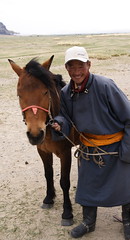
But it was cool. The jarring ride notwithstanding, I think I am starting to develop a taste for horseback riding. My new guide friend even let our horses sprint some towards the end of it — mine appeared to be the most excitable of the bunch, as most of the rest were content with strolling along at a reasonable pace (once actually just up and sat down at one point). I think if we had had more time, we might have gone further into a stretch of desert visible at the edge of the plain, but as it was we were out there for over an hour and I would've been happy to spend an hour more. Except when I got off I found myself bow-legged as hell and intensely sore... but still that was ok. After dismounting, saying our goodbyes to our guides, and wobbling our way back to camp, we had lunch in the ger restaurant and packed up to hit the road, or at least what road we could find.

There's still a good bit left to tell so I'll have to stop here and conclude with part four when I can find the time.

May 30, 2007

Once Upon A Time in the Steppes - Part Two

Read Part One // Read Part Three // Read Part Four


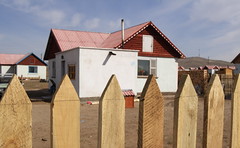
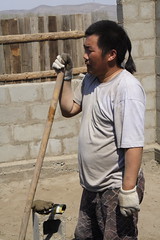
I woke up Monday morning dry, my throat parched until I chugged the remaining half-liter of water I had left standing next to my bedside. This was to be the norm for our two weeks in Mongolia — the high elevation (about 600 meters, or 2000 feet, average where we were; the national mean is about 1500 meters / 5000 feet) and cloudless skies meant essentially zero humidity and throats sucked dry overnight. Pretty much the exact opposite of Bangladesh, where we were wading through the air last year, but I did eventually get somewhat used to it, albeit only after first coming down with some sort of throat cold on the second or third day of the trip that lasted through the first week. In any case, that first day I rolled out early — 6:45ish — on account of an open window curtain and spent the morning mentally pacing before sitting down to the hotel breakfast at around 8:00, which was sausages and vegetable soup. It was good, and we were able to load up into the vans reasonably close to on time afterwards, leaving for the work site around 9:00. When the vans arrived we met Ogi, a young woman who would be our translator on-site; she was a former student of Baynaa's, she explained, although she didn't look like she could've been more than two or three years younger than him (apparently Baynaa taught English for a time at the local college before working with Habitat). We travelled to the first worksite, where we got a safety orientation from the construction supervisor, Ghana (#1), and met the homeowner, who was also Ghana (#2). Then we went to the second site and met a third Ghana (#3), who was another construction supervisor, and the homeowner on the second site, who we called Chotto even though I'm fairly sure that's not how we were supposed to be pronouncing his name. Both sites were about a ten minute drive apart from one another, on the southeast edge of town in a rundown district of shacks and gers. Chotto's house was near what had once been Russian military base, which was completely torn down to rubble after they left in 1992; he was tall with very Slavic-inclined features, in contrast to Ghana #2, whose wide face and ponytail made him look like he could've easily been one of the Khaan's riding buddies, if it weren't for the camouflage work pants.


At this point we were waiting for a load of sand to arrive from the nearby factory, so before starting work we took a short trip around to a nearby Habitat "neighborhood" where we could see what the finished houses would look like. We visited one, which belonged to a former construction supervisor; it was pretty cozy inside, I have to say. We returned from that to the first worksite and set about hauling concrete blocks out around the edge of the foundation, shoveling sand and clearing rocks. At around 10:30 I got called away with Baynaa to make a run to the grocery store for tea break snacks. The store, Darkhan's largest supermaket, was seriously better stocked than the place I shop at here in Japan... I would make this same trip every morning thereafter and get to enjoy the giant bust of Lenin looking over me from the wall as I checked out with my bag full of Korean snack cookies and Russian biscuits. Afterwards we swung by the hotel to order lunch (unprepared for this, I had to guess at random the first time) and then stopped by the Habitat offices, where I got to watch Baynaa argue with an elderly guy about something related to mortgage payments (Habitat homes aren't free; homeowners contribute the initially third of the money from their savings, with the remaining two-thirds being paid by donations and the local affiliate; the mortgage payments after the receive the house, which continue for about five years, help go towards the financing of more homes). At least I think they were arguing — Mongolian is a pretty guttural language and it can sound pretty harsh when you have no idea what they're saying (which, in my case, was more or less all the time). We returned for tea as the sand arrived, and after a short break we started mixing the cement for the walls.

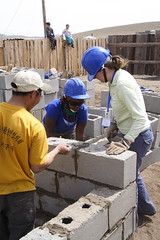
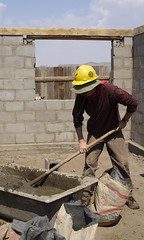
I've done a lot of different unskilled construction tasks in my seven years with Habitat but masonry was a first this time, so that was fun; the local workers got us started at the corners and then more or less let us go to it ourselves, slapping down a trowel full of cement and dropping the blocks into place. What was not fun (well, it was kind of fun, but definitely not easy) was mixing the cement in the old bathtub by hand, which I didn't do that at that point but did several more times before the trip was over. It is seriously heavy stuff, and a great way to throw out your back if you're not careful; of course, the Mongolian guys churned through it like butter, but I've learned not to try and compete with the local talent. Everybody pitched in and we had a good time, but after lunch break I think we were all feeling the burn. In the afternoon we split into two teams to start working on the second site as well, which we would continue to do every day afterwards. In the past I have seen people get very attached to the house they're working on in these situations, and I wanted to avoid cliquishness, so I did my best to rotate people around and give them a chance to work with everyone on both houses; for the most part, I think this was a success. By 5:00 a full day of carrying concrete blocks and mixing cement was definitely catching up to out-of-shape us, and we went back to the hotel to call it a day. After an embarrassing miscommunication on my part at first, we went down to dinner at 6:00 with the HFH Darkhan office staff, who had all come to welcome us. Afterwards I relaxed with some card playing and then called it a night around 11:00.

The next day was more blocklaying in the morning, up to the final tenth row — two days and we had finished the walls, which was pretty amazing to see. We continued after lunch by filling the cracks in the blocks with cement, which was fun and comparatively easy work. On the way back in the evening we stopped at the supermarket for more shopping, and ran into a WorldVision puppet show taking place outside — there seems to be a fair amount of NGO activity going on there, as we were sharing the hotel with a pair of older dentists (one from Wisconsin, the other Mississippi) who were also in town for two weeks pulling teeth. In the evening some people went to the nearby internet cafe, others watched tv — we actually had an amazing array of international channels, with the BBC news, HBO movies, National Geographic documentaries, and weird Russian MTV music videos all on regular display. (I did see one cool hip-hop video though, so if there happen to be any Russian readers out there who know the song by the guy wearing the 1920s newsie-style cap rapping with his two bandmates and then taking up the guitars to rock out, all the while interspersed with Soviet historical stock footage, please let me know what the song's called in comments here.) In a way this was kind of unfortunate, as it tended to cause people to lounge around in their rooms rather than visiting with each other, but down time is important when you're stuck travelling together with a group 24/7 and I wasn't about to push it.

Our third day we continued sealing cracks inside and out along the walls and also began mixing a special kind of cement — this one with rocks in it! — that we laid as a cap around the walltops and also as a slab on the floor where the stove would sit. We had a good morning of work and then after lunch went to visit an elementary school in Old Darkhan. The school was one of Darkhan's smaller but we got a chance to visit one class, which was (if I understood this right) a group of second-graders. The kids were, of course, adorable — after we played a few games and sang some English songs with them, they sang back to us in Mongolian, breathlessly recited some poems, and of course asked us loads of questions. Besides the free English class we brought donations of school supplies from our students back in Japan, who loaded us down with all the cute Engrish notebooks we could carry. After about an hour of visiting we said our goodbyes and returned for a little bit of work on the houses, nailing together some beams that would become part of the ceiling. We ordered dinner at the appropriately named "Nice Cafe" — by this point everyone was ready for a break from the hotel menu, which we were eating from breakfast, lunch, and dinner — afterwards and had dinner with Baynaa and our drivers there.

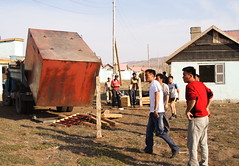
Thursday we began plastering the exterior walls with a seal of two inches or so worth of cement; slap a trowel full of cement onto a flat board, smack it against the wall, and sort of shimmy it upwards in an attempt to keep it from all falling off again in a clump before sanding it smooth with a wide circular motion of the board. This took a while for us all to get the hang of, and we had to do a few walls a second time the next day; by lunch time I was pretty exhausted. There was to be no rest for the weary, though, as after lunch I and every other guy working with Habitat Darkhan got called away for some seriously heavy lifting. Together, the fifteen or so of us managed to haul off a (rough guess) one-ton water tank and a two-ton shed, using nothing more than some scaffolding, wooden poles, and brute force: it was a pretty amazing process to watch as everybody threw in their opinion on the best way to heave these things into the back of the aging Russian dump truck that had come to transport them to a new area where HFH Darkhan would be building another neighborhood of Habitat houses. When I finally left some two hours later, the shed was hanging off the back of the truck suspending by a single metal cable.. but they're pretty resourceful guys there in Darkhan, and apparently they did finally manage to get it to their destination, somehow.

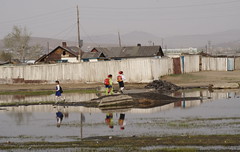
Friday morning we had something of a minor catastrophe involving laundry service at the hotel — clothes went missing initially and then after three days the bill turned out to be something on the order of twenty-five dollars for a load (the charge was per item, not per load; apparently laundry is a fair luxury in Mongolia, as we later found there were no public laundromats anywhere), which was not what we had expected, to put it mildly. People were, not surprisingly, not happy by this, but then it looked like maybe the poor bellboy who had taken the clothes might be the one who would have to pay when people refused. The whole thing was an awful miscommunication from the start and definitely not good times, but I think in the end we did manage to come to some sort of solution where we were not going to be taking six months of this poor boy's salary on account of the fact that we didn't get our clothes back on time. After that we washed our clothes in the sink. Again, not a pleasant situation, and one I was glad to be done with. We continued plastering through Friday afternoon; on the first house they were already working on roof frames, but the second site went a little slower. In the afternoon, we made a visit to a poor area of Old Darkhan, to see the kinds of shacks many Mongolians have to live in, which was hopefully an eye-opener for all of us.


Saturday morning we said goodbye to two of our team members, as both P. and Ms. Riddarfjarden were unable to stay for the full two weeks and had to catch a flight back to Japan that evening. They drove back to Ulaan Bator after a visit to the work sites in the morning to say goodbye; checking out was a little rushed and I didn't think to give them money from the group fund to help pay for their meals and such in UB, but otherwise they got there and back home fine. After they left we continued with yet more spackling; by this point in the week we were all dragging, and we were a hot and dirty bunch at lunch time. We broke early at around four and had dinner at the Nice Cafe again. That evening was the social highlight of the week — yes, that's right, we went to the disco in Mongolia. Some of the more enthusiastic team members ended up inviting just about everyone — homeowners, Habitat families, hotel workers — so it ended up being quite a crowd that rolled into Club Scorpion that night. I could say that I had a great time dancing and partying it up with the Darkhan folks... but the truth is I hate dancing and I spent most of the night sitting in a corner squinting into the glare of what seemed to be about a thousand blinding strobe lights while bad techno boomed around us. Everyone else did seem to have a good time though, so I sucked it up. It certainly was an experience, although not necessarily one I was keen to repeat.

---


This is running long so I'll save the aforementioned stuck-in-a-river-in-the-middle-of-nowhere story for Part Three, in which I also hope to finish recounting our second week of work, our three days of R&R bouncing around in a bus all over Mongolia, and my experience on horseback.

May 21, 2007

Once Upon A Time in the Steppes - Part One

Read Part Two // Read Part Three // Read Part Four


It has been two years since I organized and led a Habitat for Humanity volunteer trip. What was once regular practice — one of the dominant themes of my college social life, actually — has been relegated to anecdotes and memories during my two years expatriation in Japan. Last year's trip to Bangladesh offered a brief building fix, but then as participant rather than leader; it was enjoyable in its way, but also not what I had been used to. I doubt anyone would've predicted it during my quiet high schooler days, but three years in a position of responsibility with the Boston University Habitat organization definitely has changed me — for all the stress involved, I'd still rather be Fearlessly Leading. The unpredicted complications in the run-up to our departure were many, but "then I spent two hours wading through the Japanese post office bureaucracy" or "the correspondent bank in New York didn't have enough account information to forward our $2000 of tour money to the bank in Mongolia" doesn't make for a very thrilling travel narrative... so I'm going to begin at our date of departure and simply note that, for me anyhow, the adventure had already begun a good while back. I had booked (and re-booked) tickets, sent long exhaustive e-mails, collected donations, corresponded with our hosts, fought with my Board of Education, and chipped in about $5000 of my own money in the hope that I would eventually get it back (I did, eventually). Now it was time to actually make it happen.

---


We left from Fukuoka International Airport on the evening of Friday the 27th; we had originally planned to leave on a flight the following Saturday morning, but that waitlist never budged. Golden Week, four national holidays in the span of seven days, is probably the busiest travel season in Japan outside of maybe New Year's, and apparently a lot of people were heading to Seoul to stock up on kimchi and Yon-sama t-shirts. Luckily for the eleven of us, we were able to get onto a flight late enough in the evening that no-one would have to take off work Friday in order to make it to the airport. I caught the bus with Ms. Riddarfjarden and Erin and got to Fukuoka around 6:30; everyone else was there ready to go, so I handed out passports and tickets and we checked our bags through to Ulan Bator. The airport was pretty empty that evening so I had figured we would have no problem; but after delays changing money, having to repack a bag with all of our liquids, and there being only one grumpy guy at the emigration counter, the plane was starting to board by the time we finally got through, hot and tired. We were able to relax on the quick plane ride over, though, and got into Seoul around 10:30 in the evening. I had booked rooms at the Incheon Guesthouse, and although our initial attempt to call and have them come pick us up failed — nobody spoke English on the other end — we did get help from the airport information services. Two vans showed up not long after, whose drivers did speak English, and they whisked us away to the guesthouse, which like the one I stayed in on my trip to Busan in February, was located in a large apartment tower complex. Even so, it was pretty nice, with a kitchenette and everything — probably meant for longterm stay, I guess.

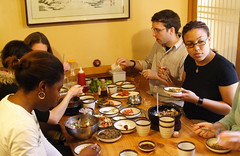
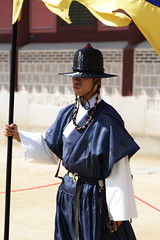
Our flight on to Ulan Bator Saturday wasn't until the evening as well so we had almost a full day to kill in Seoul; we slept in and lounged around until around 11:00ish at which point we dragged ourselves down to check out and see the city. The guesthouse drivers took us back to the airport, where we all checked buses and took one in to Anguk in Seoul, about an hour and a half away — with the plan being that some people would split up but that we would all be meeting back at the airport no later than 6:00 PM. One person split off in Anguk to meet a friend and the rest of us had a delicious Korean-style lunch; Korean food continues to be one of my favorites, especially for eating in groups. After that about half of us split for walk the Insadong street arcade and window shop at art stores, and the other half (with me included) headed to Gyeongbokgung Palace. It's Seoul's largest and grandest, until the Japanese got to it — twice, once in 1592 and then again in the 1890s. The city has crept up around it but it's currently being restored and several of the buildings are still quite impressive; also cool were the "royal guards" stationed at the gates, whose costumes visitors were able to try on. I didn't have time to see the War Memorial Museum (I was apparently the only one who wanted to go) so I'm going to have to come back to Seoul some day and check that out (and go on a DMZ tour).

The two groups met back at around 4 and we caught the bus back to the airport — although the ride was pretty jarring ("he's driving this bus like a taxi" was how Ms. Riddarfjarden described it) we did get there exactly on time, at 6:00. Unfortunately, we then proceeded to have a small panic over the fact that J., who had gone off to meet her friend, was not back yet. After several pages over the airport PA system I finally told the others to head up and start checking in, but not to leave without me and J. — I don't know what would've happened if she hadn't made it back in time, but I was not about to leave anyone behind, so it probably wouldn't have been anything good. She did finally make it there by 7:00, having missed the bus and taken an $80 cab in order to get there about 45 minutes before our plane was to depart. We got through security fast, I dashed into an electronics store to buy a universal plug adaptor, and then onto the plane we went! This was probably the most stressful moment of the trip, and it did introduce a bit of tension in the group, but ultimately luck was with us.


The flight was almost empty so I attempted to nap a little bit, but no luck; we arrived into Ulan Bator at around midnight on Saturday after a three and a half hour flight. Our first taste of Mongolia was pretty bland; the immigration hall was small and the process slow (not helped by the fact that ours closed right as we got to the front). When we did get through our bags were waiting for us, and outside so was Batbold and the rest of the Habitat team, with the van and car that would be our team's transportation for the week and a half we would spend building with the Darkhan Habitat for Humanity affiliate.

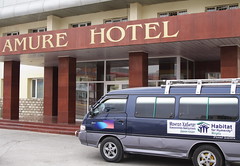
Batbold greeted us with a friendly smile and an accent that (like most Mongolians) was very Russian-sounding to my ears; he mentioned that English has only been a popular language of study since 1992, when Mongolia gave up Soviet-style socialism. We piled into the cars and strapped our bags to the roof to head off into night for our hotel in central Ulan Bator; I sat up front wedged between Batbold and the driver and we chatted through the drive. I attempted to learn a bit of Mongolia and learned that "thank you" is very hard to say (what we eventually learned sounded something like "bar-shlah", and whether that was even close I'm still not sure — a lot of tricky gutturals and blends in Mongolian). I also learned that, incidentally, tomorrow was apparently the first ever emissions-reduction day in Ulan Bator (on account of the bad smog) and maybe we wouldn't be able to drive anywhere? But we'd figure out something. (Last year in Dhaka, oddly enough, there was a similar sort of case, except that in that case it was striking opposition parties blocking the streets.) We did get to our hotel, the Amure, at around midnight, and collapsed into several rooms.

The next morning we had breakfast at the hotel (sausages and some sort pancake blobs which were better than that sounds) and then an orientation session with Batbold and Baynaa the Darkhan Affiliate Development Officer (who would be our host and my counterpart in Darkhan) in the hotel. Batbold was funny and did a very good job explaining Habitat, its mission, and its programs in Mongolia, particularly for an audience like ours where most people had not worked with HFH before. More than one wit had remarked to us before we left that "you're going to build houses for nomads?", but the reality is that since the end of socialist control and the resumption of free internal migration within the country after a seventy-year freeze, urbanization has increased rapidly as the population seeks jobs in cities like Ulan Bator and Darkhan. Over half the population lives in the cities now, where unemployment can be as high as 40%, and limited building resources (materials are often imported from China), aging and overcrowded Soviet-era housing, and high loan rates make home ownership very challenging for a lot of Mongolian families. HFH Mongolia has been in operation since 2000, with three Affiliates (building new houses) and another five Program Centers (renovating older houses) throughout the country. To date they've built 575 new houses and renovated 110, with goals for 800 this year. Two of those, we would be helping complete, and our group's donations (over $6000 worth) would go towards the construction of several more.

After our orientation we hit the streets of UB — side streets, on account of the aforementioned traffic restrictions, but it didn't turn out to be too much of an inconvenience for us. Ulan Bator was looking very dusty and very post-Communist; lots of drab concrete and industrial decay, but also interspersed with new construction, SUVs on the streets, and some pedestrians in chic European fashion. Unlike poor Bangladesh, Mongolia appears to be a developing country that actually is developing, however unevenly, thanks to the influx of Western assistance post-1992 and the commodities industry boom. We joined the ranks of millionaires after converting all of our team money into tugrug notes (a little over 1000 to the dollar) and used that to go on a short shopping trip at a local grocery store where we stocked up on bottled water. From there we made a side stop at our tour guides' offices to pay for the R&R portion of our trip, which we would be taking for our last three days in-country, and then crammed ourselves into a very tight van for the three and a half hour drive to Darkhan.

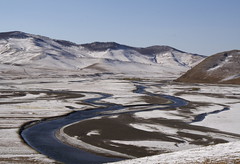
Although the legroom situation didn't get much better, the scenery did — we gradually left behind the dusty pall of UB and came out under the huge blue sky Mongolia is famous for. I've never seen a landscape quite like it before — huge expansive plains and hills stretching out from the potholed highway, dotted every now and then by a ger camp or a herd of cows, horses, or goats. Baynaa later said that, in summer, it all turns lush and green, but with spring only just beginning in Mongolia (we saw a few small patches of snow) the grasses were mostly tan and sparse. We stopped at a highway diner and after discovering the joys of open-pit toilets enjoyed a hearty meal of lamb burger and rice with ketchup... and got to check out the Mongolian high police outfit as well on some of our fellow diners, which is very Red Army-esque: military-style cap, white T-shirt with field jacket, black combat boots. I paid for lunch from the biggest bag of money the little boy next to the register had ever seen, and then we hit the road again.

We arrived in Darkhan at around 4:00 and checked into the Urtuuchin Hotel, which would be our home for the next week and a half. As I was one of only two guys on the trip (story of my Habitat career, to be honest) there wasn't much doubt as to who my roomate would be; the rest of us paired off and stowed our bags, then went down to the hotel restaurant to place orders for our dinner that evening before heading out for a tour of the city with Baynaa and "Bob", a member of the Darkhan HFH board, English translator, and teach at the local 800-student Darkhan College, which I gathered is a hospitality university. In the course of placing our orders, we met a Korean couple (the husband of which I believe was there on a mining contract?) who were either a little crazy or a little drunk or possibly both; in any case after we explained what we, a group of 11 young foreigners, happened to be doing here in Darkhan, they insisted on giving us one of every tugrug note (T10 on up through T20,000). The orientation that morning had mentioned our giving gifts to the locals — generally, it's preferred that we do it through the Habitat organization, so as to reduce dependency and potential pressure on future GV teams — but nobody told us what to do if someone was trying to give a gift to us. We eventually established that they didn't want to give us this money (it was worth at least about $35) as a donation but rather a "souvenir" to remember Mongolia by. After several protestations that Darkhan HFH could use this money much more than us — which were emphatically brushed aside — I finally caved in and took the money, which I promptly offered to Baynaa as soon as we got outside. After going back in to talk to the couple some more, he returned and said "this is your problem", which was worth a laugh at that point. So we took the money.

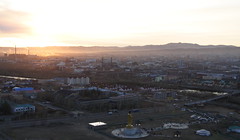
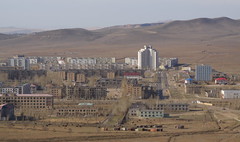
After this little episode we got in the van and car (which were a lot roomier now without the luggage) and took a short tour of the city, visiting a hill topped with a Buddhist stupa monument that overlooked both the old and new sections of town; another hill across the road featured a statue of a rider playing the horse fiddle. Darkhan has only existed since the 1960s, when it was planned and built by the Russians as an industrial town — the name means "blacksmith" in Mongolian. Today the population is around 100,000, and most of the Russians have gone home; a lot of industry has closed down but there is still some left (they pointed out a thermal power plant, sheepskin factory, and a few machine factories on our tour). We went back to the hotel and visited an internet cafe before dinner, which was good. Exhausted, I headed to bed soon after that, and so ended our first full day in Mongolia.

---


In the next part, I'll talk about our first week of work; our visit to an elementary school; and getting stuck in a river in the middle of nowhere. Excitement abounds!

April 01, 2007

Big Sky

This place has gone dormant on account of I don't really have time to keep up with blogs at the moment. My contract with JET will be ending this July and although I've got a good idea of the places I plan on traveling through on my round-the-world return, I do not as of yet have any job for when I get back to the States. I'm dividing most of my time between the wonderful Ms. Riddarfjarden and Habitat for Humanity; this May I will be leading a team of eleven volunteers to build homes under the big sky of Darkhan, Mongolia. There will be plenty of pictures and maybe a travelogue or two when I get back but for now you can see the details — and donate to the cause, if you're so inclined — here.

All for now.

August 10, 2006

A Habitat Story

Another one from my turn at the SagaBlog:


Back in elementary school, I went to a small, private Montessori school in Bloomington, Indiana. Fourth through sixth graders all shared one classroom, with about thirty students in all. Moving into a huge public middle school afterwards was a difficult social adjustment, but Montessori was a great learning environment. One of my classmates, two years below me, was a girl named Kelsey. Her father was a professor at Indiana University (as was mine), and her mother was from Africa. Which would've been unremarkable except that this was 1994 and she was from Rwanda.

Estimates range from 800,000 to well over a million killed in the Rwandan Genocide, primarily ethnic Tutsi people at the hands of organized Hutu militias. From Wikipedia's article on the topic:
Ordinary citizens were called on by local officials and government-sponsored radio to kill their neighbors and those who refused to kill were often killed themselves. "Either you took part in the massacres or you were massacred yourself," said one Hutu, rationalizing an ambivalent mixture of regret, fear, and shame at being forced to kill Tutsis.

Most of the victims were killed in their villages or in towns, often by their neighbors and fellow villagers. The militia members mostly killed their victims by chopping them up with machetes, although some army units used rifles. In some towns the victims were forcibly crammed into churches and school buildings, where Hutu extremist gangs massacred them.

Being all of eleven at the time, the full scope of this probably only vaguely registered with me at the time, but we were all definitely aware of it to some extent because Kelsey's mother was in the local paper (someone we knew was famous!) for her efforts to reunite with her family back in Rwanda. We had fundraisers at school to help her raise the money to travel to the refugee camps, searching for the scattered remnants of her family. I remember it took several trips, but she eventually was able to reunite with her mother. After some time — the details are blurry with time by now, but I think it must've taken over a year — she was finally able to secure a visa for her mother and her brother, who I believe were the only survivors in her family.


I first volunteered with Habitat for Humanity in high school; my school had a chapter and, on the suggestion of one of my favorite teachers, a sponsor of the club, a few friends of mine and I went out one Saturday to lend a hand on the house of a young woman named Jennifer. I don't remember exactly what I did that first time (I think I worked on the porch, and maybe some of the interior walls), but it was fun enough that when, later that year, the Unitarian Church that I attended at the time (that's another story) sponsored the construction of two houses out on the north side of town, I decided to go join them again. And whose house should I find myself raising the walls on my first Saturday morning there, but my old classmate Kelsey's uncle and the wife he met in the refugee camps of Rwanda some four or five years prior. And let me tell you, that was pretty cool.

Every weekend after, I dragged myself out of bed at 7:00 on a Saturday morning to drive out and take part in construction from start to near-finish: driving nails, putting up siding, drywalling, painting trim, running wiring all over the house with an old retired electrician my grandfather's age, and more. It was amazingly fun, and rewarding — and, as a teenager youth with your usual modicum of adolescent angst, also good for adding a little broader perspective to life. I continued my participation with Habitat on into college, where my constant involvement made it one of the defining aspects of my life at the time; it remains one of the things I miss most from home.


There is a Habitat for Humanity Japan affiliate, although it acts primarily as a coordinating and support service for groups taking Global Village trips to nearby countries in the Pacific. Volunteer organizations like Habitat are hard to find here in Japan; the word, ボランティア, is not native to the language and as I understand it normally carries connotations of group civic responsibility and shared sacrifice, like when my students are told to go out en masse to pick up trash along the roadside for an hour or so at school. That's good and important and all; our New Horizon third year textbooks have a unit on volunteerism, but there as well, the activities described are officially-sponsored (school groups with a partner family in Nepal — why oh why did they change it from Bangladesh this year??? I could've done a great lesson with that..) — not from grassroots.

There are a number of possible explanations for the relative absence of individual civic volunteerism in Japan. There are the obligatory references to Japan's "group culture", and the widespread influence of religious groups (Habitat, which is officially an ecumenical Christian organization, gets most of its volunteers and support from church groups, although everyone is welcome) in American social life, which Japan lacks. There's also the notion that these things are the responsibility of the government authorities, and not the general populace.

But there's also real legal impediments to the growth of non-governmental organizations (NGOs). In a 1999 article in the magazine Pacific Affairs entitled "Wither Japan's Environmental Movement? An Assessment of Problems and Prospects at the National Level", Robert J. Mason writes:
Perhaps the largest single obstacle facing NGOs is the difficulty of obtaining tax-exempt status. Indeed, 90 percent of all NGOs in Japan lack such status. To receive tax-exempt status, an NGO must be officially recognized by the government as a "public-interest corporation." Eligibility conditions for such status are not precisely specified by law, but what is generally required are either capital assets of about U.S.$ 2.5 million (¥300 million) or membership numbers beyond the reach of the vast majority of environmental organizations. What constitutes a sufficiently large membership base is decided by the ministry with which the NGO is affiliated. All public-interest corporations must be chartered by a government ministry, which will have a significant say regarding such matters as the group's activities and board membership. In short, the process is time-consuming and the requirements, while not clearly defined, can nonetheless be rigid and restrictive.

By comparison, registering an non-profit in the United States is a matter of filing a couple of forms with the IRS, which looks them over to ensure that the organization matches at least one of the large list of existing categories of charity — a process which usually only takes a couple months at most, and which is not meant to allow government or bureacucratic control of the groups. (In the UK, there's a Charity Comission, which as near as I can tell does pretty much the same thing; Canadians, Aussies, and Kiwis will have to give me a hint as to how your system works here.)


So, why are my students freezing away in dilapidated old buildings while the bureaucrats at the city hall stay warm and cozy? One possible answer is the equally underdeveloped state of Japan's volunteer organizations. A democratic government that truly represents the needs and concerns of its citizenry depends on civil society groups — churches, environmental groups, and other volunteer organizations where people associate together based on shared interests and goals — to transmit the concerns of the people to the authorities outside of the election cycle, as well as to hold them to them when it comes time to vote. So not only am I having an awesome good time when I volunteer with Habitat — I'm doing my part to keep democracy strong at the same time. And they usually have free donuts in the mornings too!

Taiwan and South Korea achieved peaceful transitions to democratic governance in the 1980s after small local religious and environmental organizations banded together to create a national movement capable of articulating a demand for reform and accountability of the government to the populace. The Chinese Communist Party — with good reason — fears just such movement today. And Karatsu — well, I'll be waiting.


Got more time to kill? Check out this site, which offers a longer article on NGOs in Japan and offers more comparisons to how they operate versus those in the U.S. For other articles I've come across relating to the broader topic of civil society, check out my del.icio.us shared bookmarks on the subject.

May 11, 2006

Back from Bangladesh

Ok, ok, so no, I was not eaten by any tigers, nor was there any romance by the riverside — it's just taken me a while to find the time where I can sit down and recall the full two weeks of my trip. I doubt I'll be able to do it much justice now, but I'd better try before it gets buried under the daily grind of Ken and Demi. So without further ado, here is another installment of "MC MasterChef's Travelogues Across Asia". If you feel like cutting straight to it, the pictures are here.

---

The start of May is "Golden Week" here in Japan, also known as "the only time the Japanese ever allow themselves to take a holiday from work besides New Year's". It's a block of three or four national holidays all in the span of a week, and many families take the opportunity to take a trip to Tokyo Disneyland, the temples of Kyoto, the beaches of Okinawa, or some other attraction during this time. Being blessed in my JET contract with twenty paid vacation days and the mercenary work ethic that allows me to burn through them all without guilt, I took a full two weeks to go visit that hot-spot of tourism... Bangladesh.

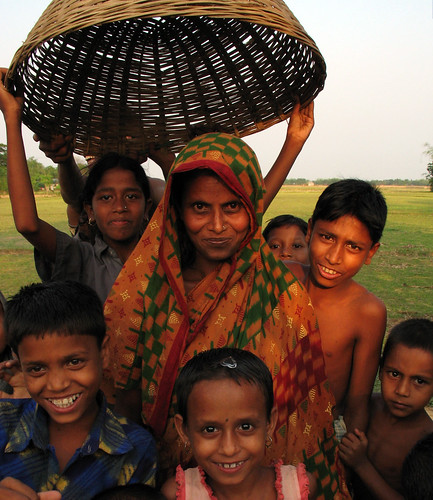
I went with a group of nine other JET teachers from my home prefecture of Saga, plus one young Japanese woman who was a friend of our team leader. The eleven of us spent the first couple of months of this year fundraising for our trip, and brought with us over $5000 in donations, which is about enough to build five solid homes in Bangladesh, including all materials, construction costs, and administration.

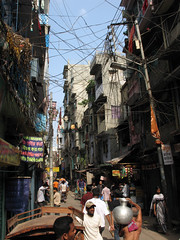
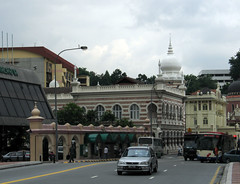
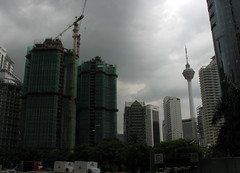
I took the bus up to Fukuoka International Airport early Saturday morning on the 22nd, where the full group met up and made our way to the plane. Oddly enough, there weren't an abundance of direct flights from Japan to Bangladesh, so we ended up going through Kuala Lumpur on Malaysia Airlines; on the way over, our layover was about six hours in KL, so we just hung around the (quite nice) airport, although the return trip gave us almost a full day to wander around the city.

No matter how far I'm going, air travel always seems to consume the whole day, and this was no exception: we arrived in Dhaka past midnight, which felt like about 3:00 AM back in Japan. We queued through immigration and picked up our bags, then stepped out into the muggy night air to face a crowd of men hanging around idly on the opposite site of high iron gates that shielded the taxi drive-up from the onlookers. We milled about uneasily for a few minutes, not sure what to do, before the HFH Bangladesh Volunteer Coordinator, whose name was Sanjay, showed up with two vans to whisk us out of there and off to our guest house for the night. As we hurtled down the nearly empty Airport Road, heat lighting rumbling overhead. Soon enough we were turning into the tree-lined Banani District, part of the upscale foreign and diplomatic quarter where most of the citie's better guest houses stand. I vividly remember passing a young Bangladeshi woman — alone as she was, at that time of night, I imagine she may have been a streetwalker — draped in a sari, standing in the shadows of a tree, with huge dark kohl-rimmed eyes staring back as our van passed.

Our first morning in Dhaka was devoted to changing money — not an easy process, as all of us had brought big blocks of yen, which the first place we went to either had no interest in or otherwise wasn't able to accomodate. Eventually we were able to get the cash taken care of, after which we went to visit the national Habitat Bangladesh offices. Besides adding another Habitat t-shirt to my ever-growing collection, I gained a bit more information about the country, which I'm really only broadly familiar with in the context of its separation from Pakistan back in 1971. A riverine country, floods and other natural disasters have taken a heavy toll on Bangladesh's development, as has serious corruption and governance problems and an increasingly dysfunctional political process — our departure from Dhaka to the Haluaghat affiliate where we would be building was delayed by several hours because opposition parties had called a general strike in an attempt to destablize the sitting government, which partisans often enforce by force . According to the briefing they presented to us, 70% of the country lives in substandard housing, of which 35 million are children. While NGOs and microcredit assistance programs are very active in the country, and the garment industry has found some success as a lost-cost exporter, its per capita income is only $440 a year, and most other indicators are not much better. If that wasn't enough, a lot of the wells dug in the past to provide clean water for the countryside turned out to have significant levels of arsenic and other heavy metals in them — it was going to be bottled water for us, but the Bangladeshis didn't all have that luxury. Put it another way: the picture of Dhaka above is taken in what is supposed to be one of the nicer parts of the city.

By early evening the roads had opened up and we were able to begin the three hour drive to the affiliate of Haluaghat. We passed some pretty amazing scenes on our way up, some of which I was able to capture despite our driver's break-neck speeds. Bangladeshi rules of the road can essentially be summarized as "everybody yields to the biggest, noisiest, fastest vehicle". It was chaotic as hell and there were a couple points where we were bearing down on a huge oncoming TATA Group heavy truck a little too fast for my liking, but amazingly the system seemed to work: rickshaw drivers really would pedal to the side of the road, and slower trucks would let you pass, and we did make it through the whole two weeks without any accidents, although sometimes I wonder how. After four hours or so of driving we arrived late at night at our guest house in Haluaghat, which was part of a hospital compound just outside the center of the market town.

Our first day of building began the next day, Monday. There were two work sites, both a ways further out into the fields and villages around Haluaghat, and I worked a bit on the first one before switching mid-week; I wanted to mix groups around to get a chance to work with everyone, but people quickly became attached to their worksites and didn't want to move. Had I been leading the trip, I think I would've made a greater effort to mix people around, but oh well. I only got the story behind the first family. They owned their own land and were living in the parents-in-law's home, and sought to move out to something more spacious and more sustainable than the tin shack they were all living in. The father-in-law and the husband of the family were both masons, so they did most of the bricklaying work while we carried bricks, wetted them down (to aid in the setting of the cement) and shovelled big piles of dirt and sand into the house to fill up the foundation and raise the floor. It was good sweaty work, of the kind that I've been increasingly desperate for during my extended time here in Japan, although late in the afternoon our labor was interrupted by a swift storm that blew up almost out of nowhere, forcing us to scramble to bring everything in before the rain came. I'm not sure if scrambling to scrape, shovel, and brush up a huge pile of drying grain into baskets while storm winds whipped up around us and the family's children all scurried to help was my favorite moment from the entire trip (and it might have been, now that I look back on it) but it certainly was an exciting way to finish a work day. We sat out the storm on their old porch and then walked back to the vans, it being too wet to do any more bricklaying for the day.

That evening we had our welcome ceremony at the local Tribal Welfare Association. The people living in the Haluaghat area were not ethnic Bangladeshis, but rather a tribal people known as the Garos, with their own distinct culture and language; as you can probably see in the pictures, many people had facial features far more reminiscent of Southeast Asia or the South Pacific than the Indian subcontinent. Not too many of them were Muslim, either, which means a lot of the cultural cautions we had been prepared against didn't actually end up applying. The welcome ceremony was pretty nice, although the master of ceremony's repeated exultations for us to welcome the next dancing group "with a big clapping!" were a little overbearing thanks to the speaker set up right next to our heads. Ah but they meant well.

The second day unfortunately was not so good — despite their having a special chef there for us at the guest house and using bottled water for everything from drinking to brushing teeth, something snuck its way down my digestive track and had me pretty well out of commission for the better part of the day, and decidedly off potato curry for the rest of the trip. I went home from the work site at about eleven, and slept until the others returned at 4:00. It sucked, because I really wanted to be working, but in the end that was it for me — and several others, like our team leader Aine, were not as lucky when they came down with stomach bugs later in the week which lasted several days.

Fortunately, after sleeping most of the day I was well enough in the evening to join the rest of a group in an excursion into town, wandering around the marketplace at Haluaghat's center. Being a gaijin in Japan sort of prepares you for being an object of attention, but Bangladeshi curiosity towards visiting foreigners is if possible several of order of magnitudes greater than what I get here in Karatsu — we drew stares everywhere we went, and when one of our group stopped to buy a pair of sandals a crowd of twenty to thirty people congregated outside to watch. We were the first Global Village team to visit the Haluaghat affiliate, and if we weren't the first foreigners to ever visit, we were certainly a rare enough appearance to merit intense interest from anyone who saw us. It could be a little off-putting, although I don't think it bothered me quite as much as it did some of the others — I never felt ill will from the crowd, just maybe a few flickers of claustrophobia at moments. I can't imagine what they must've thought about us.

Wednesday morning we went to visit a local school rather the usual build; Aine and a few others had collected large donations of pencils, notebooks, and other school supplies, and so we went to deliver that and see school life in Bangladesh. The school was a Catholic one — apparently the Portuguese came through here, way back when, and a few were still around — serving all grades; we only visited the primary school part as the secondary school students were testing during the time. Many classrooms had over sixty students to them (although that may of been the entire grade, I think) and as the headmaster told us, many came to school without basic supplies or even breakfast. They were luckier than many of their peers, though, in that they were recieving some kind of education at all; many Bangladeshi kids their age were already working, and there were regular swarms of them around the second work site, where I went after lunch. They worked alongside us carting bricks and shovelling sand — actually, they directed us on what to do, more often than not — and they also went mad whenever you pulled out a camera, so I had to be sneaky if I wanted a picture of something other than a crowd of kids pressing up on my camera. Still they were fun to work and play with, and a few older ones even spoke a bit of English.. in the interest of internationalization, we taught them how to count in Japanese too.
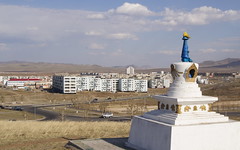
By the fourth day we were well into the rhythm of the work site, although our site had another break in the morning when a representative from another NGO in the area came to visit — word gets around about our visit — and asked if we would be interested in seeing their project. We took a break from building and drove a ways to a nearby village, where this group — I never got a name, although they suggested they were somehow affiliated with the UN — was working on improving agricultural techniques and developing artisan skills. About this time the sky opened up and dumped down several thousand gallons of rain, which meant we weren't able to see much of the facilities, but we did get an opportunity to sample some delicious, delicious chutney, which we bought about 20 jars of between the five of us. The rain blew off and we headed back along the dirt road to our build site... or should I say, the formerly dirt, now squelching mud road. This was one of the few situations where an SUV might've actually been useful, as our little minivan got itself stuck in the mud right behind a huge truck. Our driver must've done something awful to his transmission spinning his wheels trying to get out, but eventually with enough shoulder power we were able to shift the thing out, returning mud-splattered but triumphant to finish the rest of the day at work.

The next day was a solid work day — we pounded the floor level with a big cement block-tipped bamboo pole, then threw on more dirt, then pounded it flat again. Splashing bricks with water to help set the cement was also immensely enjoyable work. The next day was our final on the site, working till around 1:00, taking our farewell pictures with the family, and then returning back to the guest house to pack and prepare for the farewell ceremony, again at the Tribal Center. This time we performed a song and dance for them — "We All Want to Say Dhonnobad (Thank You) To You", to the tune of "Yellow Submarine" — and of course there were also plenty of dances for us to welcome with a big clapping. The whole thing lasted till the power cut out — not sure if that was intentional or not, but at a good two hours long, it was about time by then — after which we split up to do a "homestay" that evening. I ended up staying with two other guys and Sanjay at the house of the Haluaghat affiliate director, so homestay is perhaps overly generous — basically it was a bunch of sitting around, talking, and drinking, till far too late in the evening for me. I think everyone was pretty drained by this point, and having just bid our farewells it was a little difficult to play guest for the evening, but being in a big group I was able to let the others do the talking and excuse myself early (11:00ish) for bed. The next morning we woke up, loaded our vans, and made the drive back to Dhaka — which went allright, except for our late start and the radiator on our van blowing out on the freeway about ten minutes from our guest house. Good thing we had all those cases of bottled water...
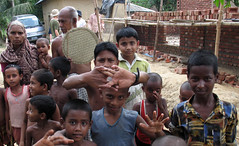
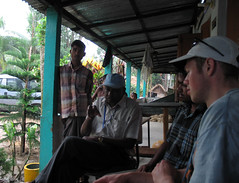
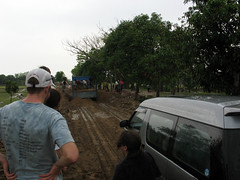
We had about four days to travel on our own, and Sanjay had earlier recommended a tour of the Sundarbans, the largest mangrove forest in the world. Bangladeshi tourist infrastructure is fairly marginal, so we all agreed that a trip downriver sounded like the best option available to fill our last few days of travel. We met our tour guide that evening in Dhaka and paid about $300 apiece for a two night, three day cruise down through the forest and back. The next day a quick early morning flight on a 20-seater prop plane took us to Jessore, from which we took a big bus another hour or so south to the large port of Khulna, where we boarded our boat for the cruise.

I kind of like the sensation of being contained in the separate world of a ship at sail, and this was quite a nice one to be spending time on, although there was a bit of cabin fever — probably inevitable given that we'd been spending the past week or more together as a group already. The cruise downriver took us all the way to the mouth of the Bay of Bengal, where on the second day we took a smaller skiff out down one of the side rivers deeper into the forest. No man-eating tigers — maybe just as well, as they kill about twenty people a year, and we had no desire to add to the tally — but there were plenty of mangroves, mudskippers, birds, and (from a distance too great for my camera) deer and monkeys to see. We went back to the boat for the lunch, then went out again to hike through a grassy area and onto a big white-sand beach for frisbee and driftwood cricket. The Sundarbans were quite beautiful, and it was a nice relaxing end to the build — although of course the trip wasn't over just yet.

Our third day we boated back to Khulna, and spent a night in a hotel there — not a very restful one, as by my estimate I got only about four hours of sleep, at best. We departed at 5:30 AM for Jessore and from there flew on to Dhaka, where we went back to our first guest house, got two rooms to drop our stuff, and — after a mere hour nap, in my case — hit the town. Unfortunately, I had only a vague notion of where I wanted to go and what I wanted to see, so I was much less successful in my explorations than some of the rest of our group who went off separately — basically, I rode around in a succession of taxis, pedicabs, and rickshaws in an attempt to find things, and ended up missing most all of the attractions Lonely Planet had promised me were around there somewhere. It was fairly frustrating — especially since some of the other groups came back with the lungis, spices, and cricket sets I had wanted to buy myself (well, maybe not the cricket set), and the only market I ever managed to find was one for sheet metal, which wasn't quite what I had in mind for a souvenir. In the end I had to admit defeat, took brief refuge in the Dhaka Sheraton cafe — a surreal island of wealth and air conditioning near the center of the city — and returned to our guest house empty-handed. So much for my day in Dhaka. There was no catching up on sleep either, as soon enough we were packing up and taxiing to the airport for our midnight departure. The music from Star Wars as we boarded the plane — Luke Skywalker's theme, specifically — was a nice touch but didn't help all that much; I'm kind of hazy on the flight so I might've dozed a little bit, but I doubt that I could've slept for much more than one or two hours of the whole six-hour flight to Kuala Lumpur.

We had almost a full 20 hours to kill in KL before our second midnight departure in a row, so there was to be no rest for the weary here. I calculated at one point that, by the time I set foot on the plane that evening, I would've gone 64 hours on somewhere between six and ten hours of sleep — although the later number was almost assuredly too generous, and it was probably closer to the former. The KL airport air conditioning was far too cold to allow any comfortable sleep on their benches (I had packed my jacket in my checked bag back in Bangladesh) so it was out to explore the city for me. KL was a marked contrast to the squalor of Dhaka — Malaysia may still be developing, but you wouldn't guess it from downtown Kuala Lumpur, which hides whatever poverty there might be there very well. Had I been a little more coherent, I would've liked to have explored it more fully, as it seems like a pretty interesting place — certainly far more multiethnic than Japan, and at least as cosmopolitan in appearance as a big city like Fukuoka or Nagasaki. Sitting in the huge KL Petronas Towers mall, I was actually very strongly reminded of America — not just because of the shops and the money on display, but also the (comparatively) diverse crowd and the fact that Malaysia fashion sense appears to be much less... uh, agressive than what you're liable to see wandering around the commercial hot spots of Japan. Of course, two hours of waiting around in a mall for the rest of my group to finish and my prolonged sleeplessness had me teetering a little bit on the edge by the end of it — mall culture is pretty disturbing even under the best of circumstances, and I was thoroughly horrified with it all by the time we escaped to dinner at the revolving restaurant at the top of the KL Tower. My appetite was pretty near gone and I was too stressed and exhausted to enjoy it, so I'm afraid it was a bit of a sour finish to the trip... finally we made it back to the airport for our flight home to Fukuoka, which I was able to sleep a little bit on, I think. Eight or more hours later, I made it home to Karatsu, where I collapsed and slept until around 9:00 PM.

I had some high hopes for this trip, and in honesty I'm not sure I can say they were totally met, although I've done this enough that I know I can't really expect every build I go on to be "the best one ever". It certainly did feel much different building overseas than it does back home, though; our biggest contribution to the process there was clearly our substantial donation, rather than the raw unskilled labor of shifting dirt and bricks, which obviously Bangladesh has a fair amount of to spare already. When you're nailing two-by-foors and installing windows and fastening hurricane strapping, you physically know your being there is contributing something to the process of improving people's lives... that feeling was slightly less evident here, although there was still enough work to go around that we could end the day good and sweaty and sore.

Being conspicuously, consciously wealthy relative to the rest of the local population was another fairly constant discomforting factor during my time there that probably had more to do with it being my first visit to a developing country than it did my work with Habitat (although doubtless a volunteering trip had me more conscious of it than travelling through by backpack would've). The priveleges of American birth is something I'm often aware of living here in Saga — I've actually been meaning to write more about it on here — but in Bangladesh you could rarely ever shake the sensation of being the rich (charity) tourists. A mere four bucks or so (more precisely, 250 taka) bought us buffet lunch at a fancy Indian restaurant with gated entry, guards, and a good dozen or more waiters (despite the fact that the buffet was self-serve). The feeling of being filthy rich was one of the subtle differences between building back at home and volunteering in a developing country that gave me this sense of, "we can't possibly be doing enough here".. the raw poverty of Dhaka and the remoteness of the Bangladeshi countryside limited my ability to take great satisfaction in a job otherwise well done. Habitat for Humanity is not set up to — realistically, cannot — help everyone in the world, but the limited state of development in Bangladesh made it harder to celebrate our accomplishments at the end of the build; there was clearly so much more that needed to be done. I do believe that helping individual families is worth doing, if for no other reason than to make a difference in some people's lives, and for having at least tried, but there's clearly much more to overcome in a country like Bangladesh than what I'm used to back home. Our visit to the school apparently inspired some of the students and teachers there to start their own volunteer group, though, so there's still hope for improvement, however incremental it might be.

All in all it was quite the trip, and I'm sure I'll be digesting its impact on me more as time passes. There's already talk of a trip to Nepal next year, although if that's the case I may not be leading it after all.. which would be sort of a shame, since, as fun as being a HFH participant is, I miss being Fearless Leader most of all. That's far in the future for the moment though, and for now I'd better stop here before this gets any longer.